※本ページはプロモーションが含まれます
Disclosure: This post contains affiliate links. If you buy through them, we may earn a commission at no additional cost to you. Learn more.
If you’ve bought a “Pokémon plush” on a marketplace app for $6 and it arrived lopsided, chemical-smelling, and nothing like the reference art, you’ve already met the problem this guide solves. The plush collectors actually trust comes from San-ei Boeki, the Tokyo-based toy maker that’s held the official Japan-region Pokémon plush license for decades and produces the ALL STAR COLLECTION — the line sold at Pokémon Center Japan and licensed retailers, built to a sculpt-accuracy and fabric standard the $6 marketplace listings simply don’t meet. This guide covers what actually makes that line different, how its size tiers work, which characters are worth grabbing right now, and whether importing from Japan makes sense versus buying the North American licensee’s plush instead.
What actually makes San-ei Boeki’s line different from generic plush
San-ei Co., Ltd. (San-ei Boeki) was founded in 1938 and is one of Japan’s largest plush manufacturers, holding official licenses across Nintendo properties — Mario, Zelda, Kirby, Pikmin, Animal Crossing — plus Sonic the Hedgehog since 2007. Pokémon’s ALL STAR COLLECTION is its flagship line for the franchise, sold through Pokémon Center Japan and authorized retail rather than through third-party marketplaces, and it’s been running long enough to reach numbered series in the high 20s by the mid-2020s, with new waves shipping several times a year.
Three things separate it from a bootleg:
- Official licensing, not just “Pokémon-themed.” Every ALL STAR COLLECTION plush is produced under license from The Pokémon Company, with the tags and packaging to prove it — a real distinction, since unlicensed sellers can legally call a plush “inspired by” a character without any of that oversight.
- Fabric and construction quality. Genuine San-ei plush use consistent, tightly-stitched seams, felt or embroidered facial details (not painted-on lines, which is one of the most common counterfeit tells), and minky-style fabric that holds its shape after repeated handling rather than going lumpy.
- Sculpt accuracy to the character design. San-ei’s design team works from the same reference model sheets used in official art, so proportions — ear length, tail shape, color-blocking — track the games and anime closely. Bootleg sellers frequently work from a screenshot and eyeball the proportions, which is why fake plush so often look “close but off”: droopy fins, missing toes, or a head-to-body ratio that’s noticeably wrong.
None of that means every San-ei release is flawless — quality control on any mass-produced toy line varies release to release, and even genuine ALL STAR COLLECTION plush occasionally arrive with a slightly off-center seam. But the baseline is a different tier of product than an unlicensed import.
Understanding the size tiers
ALL STAR COLLECTION plush are sold in a handful of standard size classes, though the exact centimeter height within a class varies by character — a legendary Pokémon with a naturally larger in-game design (like Reshiram or Zekrom) can measure noticeably bigger than a same-tier plush of a small character like Pichu, because San-ei scales the sculpt to the Pokémon’s actual proportions rather than forcing every plush in a tier to an identical height.
| Tier | Typical height | Typical price (JPY) | Best for |
|---|---|---|---|
| Mascot / keychain | ~10-13cm | ¥2,500-¥3,000 | Bag clips, desk display, budget starters |
| S (standard) | ~15-25cm | ¥2,700-¥6,300 | The core of the line — most characters release at this size first |
| M (medium) | ~30-34cm | ¥5,800-¥12,600 | Shelf centerpieces, popular Eeveelutions and starters |
| L (large) | ~45-47cm+ | ¥6,000+ | Flagship characters only (Pikachu is the most common L release) |
Prices above are approximate ranges observed via Discovery Japan Mall’s live catalog as of August 2026 and will move with character popularity, fabric cost, and exchange rates — this isn’t financial advice, and a hot new release can sell out and resell well above the original tag price within weeks.
Popular characters worth grabbing right now
The catalog below is pulled from real, in-stock ALL STAR COLLECTION listings — not a hypothetical wishlist — spanning the mascot through L size tiers, via Discovery Japan Mall, which ships genuine Japanese retail stock internationally.
Mascot tier: Mimikyu

The Pokémon ALL STAR COLLECTION Mimikyu Mascot Plush, 13cm is a good entry point if you’re testing whether import shipping is worth it before committing to a bigger, pricier piece — Mimikyu’s ragged-costume design also happens to translate especially well to San-ei’s stitched-detail approach.
S tier starters: Charmander and Piplup

The Pokémon ALL STAR COLLECTION Charmander (S) Plush, 17.5cm and the Sanei Boeki Pokémon ALL STAR COLLECTION Piplup (S) Plush, 15.5cm represent the standard S-tier price point — starters are reliably in the line’s rotation since they’re perennial sellers at Pokémon Center Japan.

S tier legendaries: Lugia and Darkrai

Legendary and mythical Pokémon are where the S tier’s size variance shows up most: the Pokémon ALL STAR COLLECTION Lugia (S) Plush, 20.5cm and Pokémon ALL STAR COLLECTION Darkrai (S) Plush, 22.5cm both run larger than a typical S-size starter despite sharing the same size label, since San-ei sizes each sculpt to the character rather than a fixed mold.

A current-gen pick: Miraidon

The Sanei Boeki Pokémon ALL STAR COLLECTION Miraidon (S) Plush, 34.5cm is a good example of a newer-generation legendary getting the ALL STAR treatment — at nearly 35cm it’s technically labeled S tier but sits well into what most collectors would call M-size territory, and it’s priced accordingly above the typical S range.
M tier: Eevee and Lucario

The Pokémon ALL STAR COLLECTION Eevee (M) Plush, 32cm is one of the line’s most consistently popular M-tier releases — Eevee and its evolutions are perennial best-sellers across every San-ei size class. The Pokémon ALL STAR COLLECTION Lucario (M) Plush, 33cm sits at a noticeably higher price point than most M-tier releases; fighting/steel-type sculpts with more complex detailing (spikes, aura appendages) tend to cost more to produce, and that shows up in the tag price.

L tier flagship: Pikachu

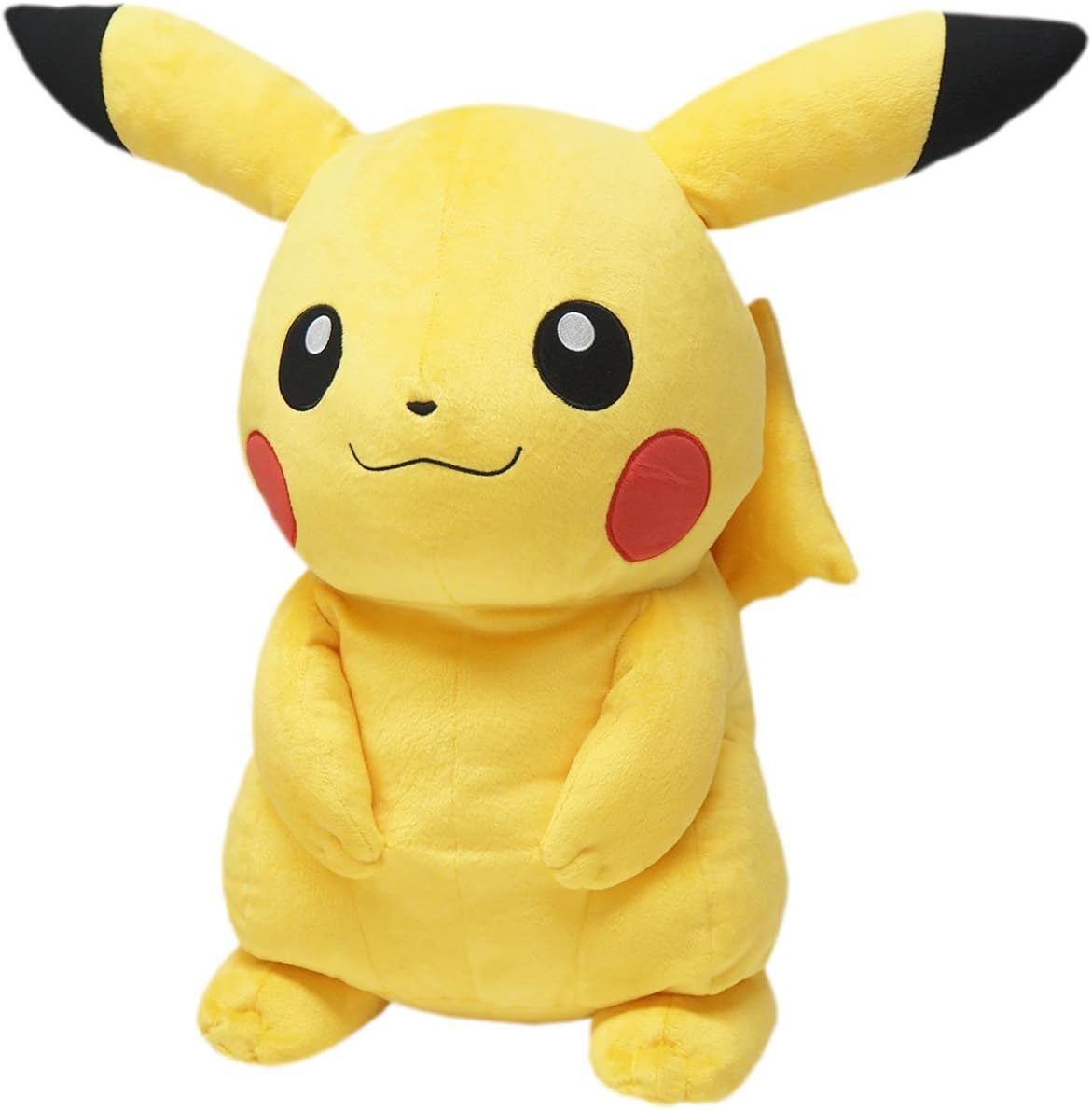
Pikachu is the character most reliably given L-tier treatment. The Pokémon ALL STAR COLLECTION Pikachu (L) Plush, 47cm is a genuine shelf centerpiece at nearly half a meter tall, and it’s usually the easiest large-size ALL STAR piece to actually find in stock, since Pikachu gets restocked far more often than other characters at the same tier.
How importing from Japan compares to buying domestically
Here’s the trade-off collectors outside Japan actually face: San-ei Boeki holds the Japan-region Pokémon plush license. In North America, the officially licensed plush you’ll find at retail — Target, Amazon, the Pokémon Center US storefront — mostly comes from Jazwares (via its Wicked Cool Toys division), which has held the Pokémon plush license for regions outside Asia since 2017. Both lines are 100% official and legitimately licensed; they’re simply different manufacturers with different sculpts, sizing conventions, and character selection, not one being a “real” version and the other a knockoff.
| Factor | Importing San-ei (Japan) | Buying Jazwares (domestic US/EU) |
|---|---|---|
| Character selection | Deep back catalog, region-exclusive characters and forms | Curated selection focused on current-gen popularity |
| Sculpt style | Softer, rounder “chibi” proportions consistent with Japanese Pokémon merch aesthetic | Slightly different proportions, generally larger standard sizes |
| Price before shipping | Often cheaper per plush at the tag price | Comparable or higher at US retail, no import wait |
| Shipping cost/time | Added freight from Japan; multi-week transit is typical for standard shipping | None — same-week domestic delivery |
| Availability | Older/discontinued series can be genuinely hard to find even in Japan | New releases restock predictably at major retailers |
| Authenticity risk | Low if bought from an authorized import reseller; high if bought from an unverified marketplace listing | Low — sold directly through licensed retail |
The catch with importing: shipping weight adds up fast on plush specifically, since they’re bulky-but-light, meaning the per-item shipping cost from Japan can rival the plush’s own price on a single-item order. It gets more economical when you bundle several plush into one shipment. And because ALL STAR COLLECTION was never designed for export, some older or regionally-exclusive characters simply aren’t available through the Jazwares line at all — that’s the actual reason to import, not “the Japanese version is objectively better.”
How to spot a bootleg before you buy
Because ALL STAR COLLECTION plush command a real secondary-market premium, they’re also one of the more commonly counterfeited Pokémon products online. A few checks that catch most fakes:
- Stitched vs. painted details. Genuine San-ei plush embroider or felt-applique facial features and markings. If a face looks painted or printed flat onto the fabric, that’s one of the most reliable counterfeit tells.
- Seller inventory red flags. A “rare” or discontinued character listed with “10+ available” at a price well under typical resale value is a mass-production bootleg signal, not a lucky find.
- Actual product photos, not stock images. Legitimate resellers photograph the specific unit for sale. Sellers reusing the same stock photo across dozens of “different” listings are a warning sign.
- Tags and hang-tag details. Genuine San-ei/Pokémon Center tags include the official Pokémon Company licensing mark and a PP-series product code; missing, blurry, or misspelled tag text is common on counterfeits.
- Fabric feel and smell. A rough texture or strong chemical odor straight out of the packaging is a common bootleg symptom — legitimate San-ei plush use consistent, soft minky-style fabric with no off-gassing smell.
None of this means every off-brand Pokémon plush is a scam — there are licensed novelty and prize-game (UFO catcher) lines that aren’t part of ALL STAR COLLECTION but are still legitimate. The issue is specifically unlicensed counterfeits sold as if they were San-ei or Jazwares product.
FAQ
Is San-ei Boeki plush the same as what’s sold at the US Pokémon Center store?
No. San-ei Boeki holds the official Japan-region Pokémon plush license, while Jazwares (via Wicked Cool Toys) has held the license for regions outside Asia since 2017. Both are genuinely official, but they’re different manufacturers with different sculpts and size conventions, so a US Pokémon Center plush and a San-ei ALL STAR COLLECTION plush of the same character can look noticeably different.
Why do two “S size” plush from the same line have different heights?
San-ei scales each sculpt to the character’s actual in-game proportions rather than forcing every plush in a size tier to an identical height. A naturally large legendary like Miraidon can measure well into what most collectors would call M-tier territory while still being labeled S, because the tier reflects roughly where it sits in San-ei’s production/pricing bracket, not a fixed centimeter target.
Is it cheaper to import from Japan than buy domestically?
The tag price is often lower, but international shipping on bulky, lightweight items like plush can erase much of that savings on a single-item order — it gets more cost-effective when you consolidate several plush into one shipment. The real reason to import is usually character selection (older series, region-exclusive forms), not per-item savings.
How do I know if a Pokémon plush I’m buying online is a genuine San-ei product?
Check for stitched (not painted) facial details, a proper Pokémon Company licensing tag with a PP-series product code, actual photos of the specific unit rather than reused stock images, and a seller who isn’t listing “rare” characters in bulk quantities at suspiciously low prices.
Does San-ei still release new ALL STAR COLLECTION plush regularly?
Yes — the line has run continuously for years with new numbered series shipping multiple times annually, covering both current-generation Pokémon and revisiting older-generation characters that hadn’t previously gotten a plush.
The takeaway
San-ei Boeki’s ALL STAR COLLECTION isn’t the only legitimate Pokémon plush line — Jazwares’ domestic US product is equally official — but it’s the deepest, longest-running one, and its sculpt accuracy and construction quality set the bar unlicensed sellers routinely fail to hit. If you want a character Jazwares hasn’t produced, or you specifically want the San-ei sculpt style, importing makes sense once you’re ordering enough to make the shipping worthwhile. If you just want a well-made Pikachu or Eevee without the wait, the domestic licensed option is the easier call — either way, the checks above will keep you out of counterfeit territory.
For more on navigating imports from Japan generally, see our guide on importing Japanese vs. English Pokémon cards, and if you’re new to buying Pokémon merchandise online at all, our guide to buying Pokémon cards online safely covers marketplace red flags that apply just as much to plush as to cards.
More Trading Card Game Guides
- Japanese vs English One Piece Card Game: Full Buying Guide (One Piece Card Game)
- Dragon Ball Fusion World vs Pokémon vs One Piece TCG: The Real Comparison (Dragon Ball Super Card Game)
Comments