※本ページはプロモーションが含まれます
If your goal is a specific card or a competitive deck, buy the singles — the math almost always favors it, sometimes by 5–20x. If your goal is the experience of ripping packs, or you genuinely don’t care which cards you end up with, a booster box is a reasonable (if usually money-losing) way to spend an afternoon. The right answer really does depend on what you’re actually trying to accomplish, so let’s run the numbers using real prices from Pokémon TCG: Mega Evolution — Pitch Black (set code ME05), the current mainline set as of early August 2026.
- The short answer, by goal
- How booster box economics actually work
- Goal 1: You want one specific card
- Goal 2: You’re building a Standard-legal competitive deck
- Goal 3: You’re buying as an investment
- When opening a box actually is the smarter move
- Q&A: Is it ever smart to buy a sealed box just to resell it unopened?
- Booster box vs. singles at a glance
- FAQ
- The takeaway
- Related Articles
- More Trading Card Game Guides
The short answer, by goal
| Your goal | Better strategy | Why |
|---|---|---|
| Get one specific chase card | Singles | Buying the card directly is almost always cheaper than gambling for it in packs |
| Build a Standard-legal competitive deck | Singles | Decks pull from a dozen+ different sets; no single box can supply a decklist |
| Complete a full master set (every card/rarity) | Mixed — usually still leans singles | Boxes give volume but duplicates and non-target pulls need to be resold to offset cost |
| Just want the “opening packs” experience | Booster box | You’re paying for entertainment, not guaranteed value — and that’s fine if you know it going in |
| Flip sealed product for long-term appreciation | Neither is a sure thing | Modern print runs are large; most recent-set sealed product doesn’t reliably outpace singles appreciation, and this isn’t financial advice either way |
How booster box economics actually work
A Pitch Black booster box contains 36 packs and has carried an MSRP in the neighborhood of $144, though early post-launch street pricing on TCGplayer and local game stores ran closer to $155–$165 in the first few weeks after the July 17, 2026 release. For this article’s math, I’m using $155 as a representative box price — check current listings before you buy, since prices shift week to week.
Pitch Black’s 120-card set breaks down like this, based on set data pulled directly from the Pokémon TCG API:
| Rarity tier | Cards in set | Est. pull rate per pack | Expected pulls per 36-pack box | Approx. value per card (early Aug. 2026) | Est. value contribution per box |
|---|---|---|---|---|---|
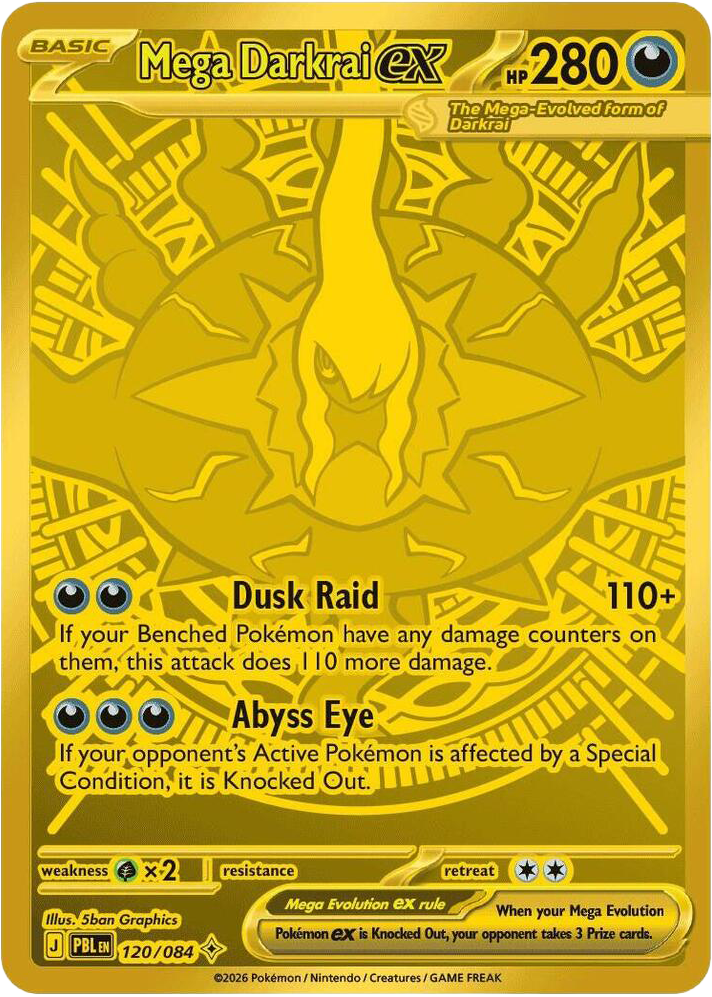
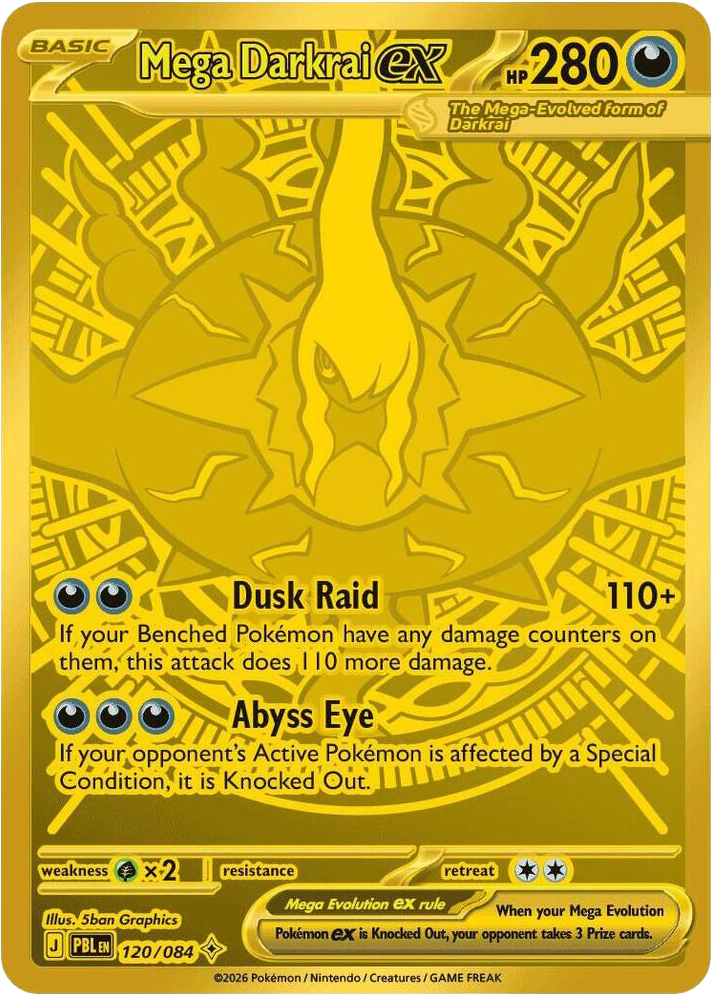
| Mega Hyper Rare (Mega Darkrai ex #120) | 1 | Unconfirmed — community trackers estimate roughly 1 in a few thousand packs | ~0.01–0.02 | ~$600 (early Japanese comps) | ~$6–10 |
| Special Illustration Rare (6 cards, incl. Mega Darkrai ex #116, Mega Zeraora ex #114) | 6 | ~0.9% combined | ~0.32 | $15–$400, roughly $70 blended average | ~$23 |
| Illustration Rare (11 cards, incl. Goldeen #87, Fomantis #85) | 11 | ~11.1% combined | ~4.0 | $5–$25, roughly $14 average | ~$56 |
| Ultra Rare (18 cards) | 18 | ~25% combined (est.) | ~9.0 | Mostly under $5 | ~$27 |
| Everything else (commons, uncommons, reverse holos, energy) | 84 | Remainder | Rest of the 360 cards in a box | Bulk value, pennies each | ~$5 |
| Total estimated expected value | ~$117–$121 |
Against a $155 box, that puts expected return at roughly 75–78% of what you paid — meaning on average, opening a box is a losing proposition versus its own retail price, before shipping or tax. That’s not unusual; it’s how the economics of most modern booster products work, since the company (and the retailer) both need margin, and someone has to pay for the SIRs and Mega Hyper Rare that occasionally show up.
To be clear about the caveats here: the pull-rate figures above (especially for the Mega Hyper Rare) are community-tracked estimates from early box-opening data, not officially published Pokémon Company statistics, so treat the exact numbers as directional rather than precise. Variance is also huge — plenty of people crack a box and land a $300+ SIR, and plenty crack a box and get nothing above $20. This is expected-value math across many boxes, not a promise about any single box you open.
Goal 1: You want one specific card
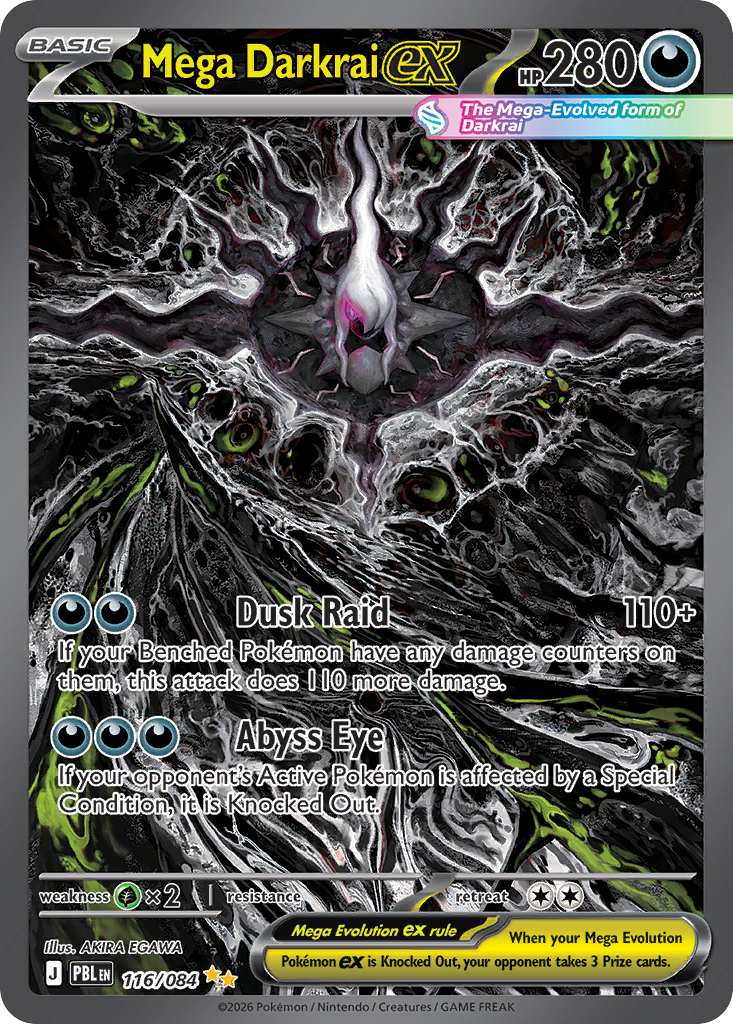
Say you specifically want the Mega Darkrai ex Special Illustration Rare (#116), currently trading around $290–$400. There are 6 SIRs in the Pitch Black pool, and if the ~0.9% combined SIR rate is split roughly evenly across them (a simplifying assumption — Pokémon doesn’t publish per-card odds), your odds of pulling that specific card are around 0.15% per pack. At roughly $4.30/pack (a 36-pack box at $155), the average cost to pull one specific SIR by buying packs works out to somewhere around $2,800–$3,000 in packs — 7 to 10 times what the single costs outright.
The gap gets even more extreme at the very top of the rarity chart. If the Mega Hyper Rare (#120) really does land around 1 in a few thousand packs, the average cost to pull it via packs runs into the five-figure range, against an early market price around $600. Even accounting for the fact that “several thousand” is a fuzzy, unverified estimate, there’s no reasonable version of that math where chasing the card through packs beats just buying the single.
The one real downside to buying singles directly: counterfeit risk. A $300+ single bought from an unverified seller carries real fake-card risk, especially for a hot new chase card like this one. Stick to established marketplaces or PSA/CGC-graded listings, and compare card weight, holo texture, and font details against official images before paying a premium price for a raw copy.
Goal 2: You’re building a Standard-legal competitive deck
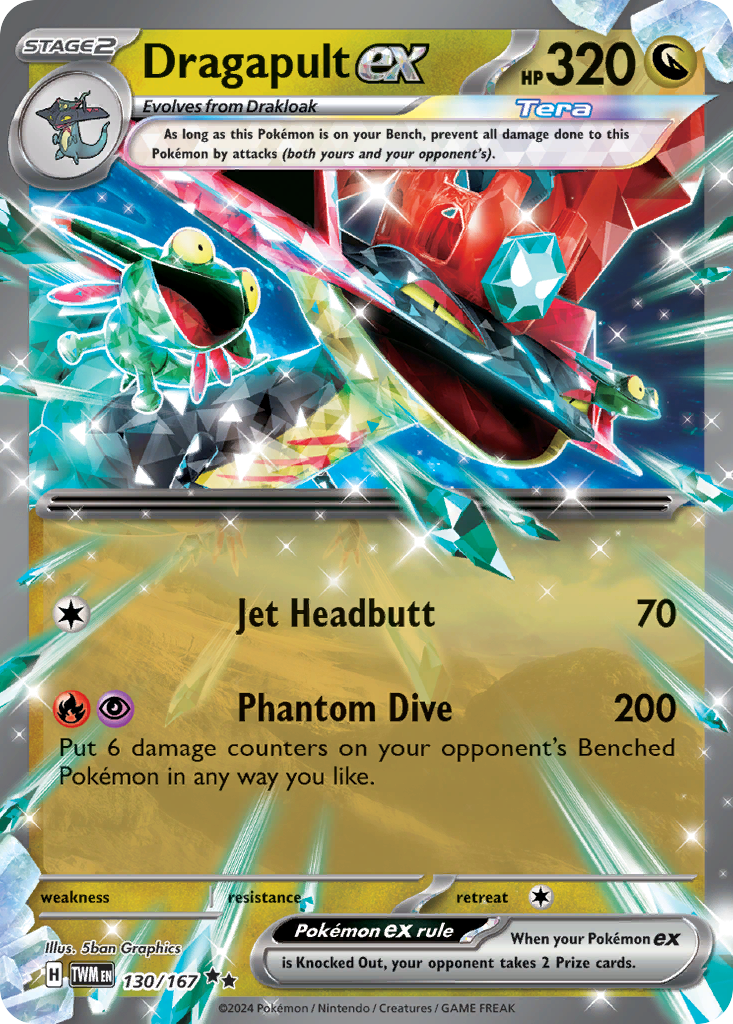
This is where singles aren’t just better value — they’re basically mandatory. Take Dragapult ex, still the deck to beat in Standard as of late July 2026 (we cover the full Pokémon TCG Standard Tier List: July 2026 Meta Guide). The playset copy most players actually run — Dragapult ex, Double Rare #130 from Twilight Masquerade — was trading for roughly $2–$2.34 on TCGplayer as of early August 2026. Buying the two or three copies a deck typically needs costs under $10.
There’s no version of “open packs until you get this” that makes sense here, for two reasons: first, Twilight Masquerade isn’t even the current set, so fresh Pitch Black boxes won’t contain it at all — Standard decks routinely blend cards from a dozen-plus different sets released over the past year and a half (Twilight Masquerade, Journey Together, Prismatic Evolutions, Surging Sparks, and the Mega Evolution sets, among others). No single box, no matter how many you crack, can hand you a complete decklist. Second, even for staples that are in the current set, packs give you one random card out of the entire set pool — a genuinely inefficient way to acquire a specific 2-of or 4-of you already know you need.
The downside of buying deck singles: you miss out on the “extra stuff” a box gives you — bulk commons, energy, and trade fodder that some players find useful for casual games or trading with friends. If that’s part of the appeal for you, a box (or at least a booster bundle) still has a place in your buying plan alongside singles.
Goal 3: You’re buying as an investment
This is the murkiest of the three goals, and it’s worth being honest about it: neither sealed boxes nor singles are a reliable investment right now, and nothing here is financial advice. A few things worth knowing before you treat either as a store of value:
- Modern print runs are large. Unlike Base Set or early Neo-era product from the late 1990s, current Mega Evolution era sets print in high enough volume that most fresh sealed boxes won’t meaningfully outpace inflation, let alone deliver dramatic returns, within a year or two of release. The sealed-box appreciation stories you hear about almost always involve product that’s 15–25+ years old and has had most of its print run opened or lost over decades.
- Reprint risk hits chase singles too. Special Illustration Rares and Mega Hyper Rares from earlier Mega Evolution sets (ME01–ME03) have already softened in price as post-launch supply caught up with initial hype — the same pattern is likely for Pitch Black’s chase cards once the early scarcity window closes.
- Grading can add real value to singles, but it’s not free money. A PSA 10 of a $300 SIR can sell for meaningfully more than a raw copy, but grading fees, turnaround time, and the real chance of a lower grade all eat into that math. It’s usually only worth it for cards already worth well above grading-fee territory — we go deeper on this in our grading breakdown.
- Sealed product has liquidity limits. A sealed box is worth more as a complete, unopened unit than as scattered singles in some cases, but reselling sealed product means finding a buyer willing to pay near retail, which isn’t always fast or guaranteed, especially outside of hype windows right after a set launches.
If you do want exposure to both sides, the more balanced approach a lot of long-time collectors use is: keep one sealed box or ETB untouched as a long-shot hold, and buy the specific singles you actually want to own or display separately, rather than betting everything on packs.
When opening a box actually is the smarter move
None of this means booster boxes are a bad purchase, full stop — there are legitimate reasons to buy one:
- You want the experience. Ripping 36 packs is genuinely fun, and if you’re budgeting for entertainment rather than expecting a return, the math above doesn’t really apply — you’re paying for the activity, not the cards.
- You’re building bulk/trade stock. If you play casually or trade with friends, a box gives you a pile of commons, uncommons, and energy that would be annoying and slow to assemble one single at a time.
- You’re going for a full master set with resale in mind. If your actual goal is owning every card in a set, buying a box or two and reselling the duplicates and cards you don’t need can sometimes beat buying 120 individual singles piece by piece, once you factor in the time and shipping costs of dozens of separate single purchases — though this only works out if you’re willing to put in the effort to resell what you don’t want.
- Group breaks spread the risk. Splitting a box or case with other collectors (a “group break”) lowers your buy-in while keeping a shot at a big hit, which is a reasonable middle ground between full box risk and buying singles outright.
Q&A: Is it ever smart to buy a sealed box just to resell it unopened?
A: Sometimes, but it’s speculative and time-sensitive rather than a reliable strategy. Sealed boxes of a hot new set can sometimes be flipped for a modest premium in the first few weeks after release, when retail allocation is tight and demand is highest — that’s part of why Pitch Black boxes were trading above MSRP right after the July 17, 2026 launch. But that premium usually shrinks as more product reaches shelves, and there’s no guarantee it holds. If you’re buying sealed product specifically to flip, treat it as a short window opportunity tied to launch-week scarcity, not a long-term investment plan.
Booster box vs. singles at a glance
| Strategy | Best for | Typical cost example | Main risk |
|---|---|---|---|
| Booster box (36 packs) | Entertainment, bulk/trade stock, master-set building | ~$155 for a Pitch Black box | Expected return roughly 75–80% of retail price on average |
| Booster bundle (6 packs) | A cheaper taste of a new set without full box commitment | Roughly a sixth of box price, similar per-pack odds | Same underlying pull-rate math, just smaller sample |
| Singles (specific card) | Chasing one exact card, deck-building | $2 (Dragapult ex playset copy) to $400 (Mega Darkrai ex SIR) | Counterfeit risk when buying from unverified sellers |
| Group break | Lower-cost shot at a box/case hit | Varies by breaker, usually a fraction of full box cost | You don’t control which cards/slots you’re assigned |
You can pick up Mega Evolution: Pitch Black Booster Box, the more budget-friendly Mega Evolution: Pitch Black Booster Bundle, or go straight for a single like the Mega Darkrai ex Special Illustration Rare Single (Pitch Black #116) or a Dragapult ex Single (Twilight Masquerade #130) playset for deck-building, depending on which column above matches your goal.
FAQ
Is it cheaper to build a competitive Pokémon TCG deck with singles or booster boxes?
Singles, by a wide margin, in almost every case. Competitive decks pull specific cards from many different sets released over the past year or more, and packs only give you random cards from whichever single set you’re opening. Buying exactly the copies you need as singles is both cheaper and far more time-efficient than opening packs and hoping.
Do booster boxes ever have better expected value than buying singles?
Rarely, and mostly for the least valuable tier of cards. Bulk commons, uncommons, and energy are effectively “free” byproducts of opening a box, and if your goal genuinely is a large volume of low-value cards for trading or casual play, a box can be efficient for that narrow purpose. For anything above roughly $10–15 in single-card value, buying the specific single almost always wins.
How do I avoid buying counterfeit Pokémon singles online?
Buy from established marketplaces (TCGplayer verified sellers, eBay sellers with strong long-term feedback, or PSA/CGC-graded listings) rather than unverified social media sellers or marketplace listings priced dramatically below market. Compare card weight, holo texture, and font details against official images from Pokemon.com, and be especially cautious with any high-value single (like a $300+ SIR) priced well under typical market rates — that’s the clearest red flag.
Are Pitch Black singles and boxes still Standard-legal, or will they rotate soon?
Pitch Black released July 17, 2026 and is fully Standard-legal now. Pokémon typically rotates the format roughly once a year (the last rotation was April 10, 2026, cutting all G-regulation-mark cards), so Pitch Black cards should stay tournament-legal well into 2027 at minimum — but always confirm the current rotation date on Pokemon.com before entering a sanctioned event.
Should I open a box myself or join a group break?
It depends on your risk tolerance and budget. Opening your own box means you keep everything you pull, good or bad, and the full box-level variance is yours alone. A group break lowers the buy-in and spreads risk across multiple people, but you typically don’t control which specific packs, slots, or teams you’re assigned, so you could end up with far less than a full box’s worth of value even if the break as a whole hits well.
The takeaway
There’s no single winner between booster boxes and singles — it genuinely depends on what you’re trying to get out of your purchase. If you want a specific card or you’re building a Standard-legal deck, singles win the math almost every time, sometimes dramatically, and it’s not close for anything above the $10–15 range. If you want the rip-open-a-pack experience, bulk trade stock, or you’re building toward a full master set with a plan to resell extras, a box (or a group break to lower the buy-in) is a reasonable choice — just go in knowing the expected value of a modern booster box typically runs below its retail price, and treat any of this as entertainment spending or a long-shot collectible, not a guaranteed return. Prices and pull-rate estimates here reflect early August 2026 and will keep moving as Pitch Black’s post-launch supply settles, so double-check current listings before you buy either way.
Related Articles
- Pokémon TCG 30th Celebration: What’s Really in the Box
- Pokémon TCG Beginner’s Guide 2026: What to Buy First
More Trading Card Game Guides
- One Piece Card Game: Booster Box vs. Starter Deck Value (One Piece Card Game)
- Fusion World Booster Box vs. Starter Deck: Best Value (Dragon Ball Super Card Game)
- Which Naruto TCG Should You Start With in 2026? (Naruto Card Game)
Comments