※本ページはプロモーションが含まれます
Disclosure: This post contains affiliate links. If you buy through them, we may earn a commission at no additional cost to you. Learn more.
If you’re starting the Pokémon TCG from zero in 2026, don’t buy a booster box first. Start with a $20-25 Battle Deck or a single Elite Trainer Box from a current Standard-legal set, learn the rarity symbols on the bottom edge of the card, and figure out what “rotation” means before you spend real money on singles. That’s the short version — here’s the full breakdown of what to buy, what to skip, and the mistakes that quietly drain beginners’ wallets.
I say this as someone who came back into the hobby a few years ago after a decade away and immediately overpaid for a “near mint” card that turned out to be a well-loved binder card and bought a booster box of a set that rotated out of tournament legality four months later. Both were avoidable. Here’s how to skip that learning curve.
- What to buy first: decks, boxes, and packs compared
- How rarity actually works (read the bottom-right symbol)
- Understanding rotation: why “Standard legal” matters
- Common beginner mistakes (and how to avoid them)
- Budget-friendly ways to start collecting or playing
- Should you get cards graded (PSA/CGC) as a beginner?
- FAQ
- The takeaway
- Related Articles
- More Trading Card Game Guides
What to buy first: decks, boxes, and packs compared
There’s no single right answer — it depends on whether you want to play or collect — but here’s how the entry-level products stack up as of August 2026.
| Product | Typical price | What’s inside | Best for |
|---|---|---|---|
| Single booster pack | ~$4.50 (MSRP) | 10-11 cards, 1 guaranteed rare or better | Curious first-timers, stocking stuffers |
| Battle Deck (e.g. Pikachu ex Deck) | ~$12-20 | One pre-built 60-card deck, ready to play | Learning the rules fast, casual kitchen-table games |
| Battle Academy box | ~$25-30 | Two starter decks, playmat, rulebook, dice | Teaching a friend or kid the rules from scratch |
| Elite Trainer Box (ETB) | ~$45-50 MSRP (often $55-65 retail due to demand) | 9 booster packs + sleeves, dice, dividers, a promo card | New collectors who want packs plus useful accessories |
| Booster box (36 packs) | ~$140-165 MSRP | 36 packs of the same set | Only once you know you like a specific set — not a beginner buy |
For most beginners, the honest recommendation is: grab one Battle Deck to actually learn how turns, energy, and attacks work, then pick up one Mega Evolution: Ascended Heroes Elite Trainer Box (or whatever the current Standard-legal ETB is) if you want to start opening packs and building a collection. Skip the booster box until you’ve opened enough single packs to know you actually like the set’s card pool — booster boxes are a bulk-buy decision, not a starter decision.
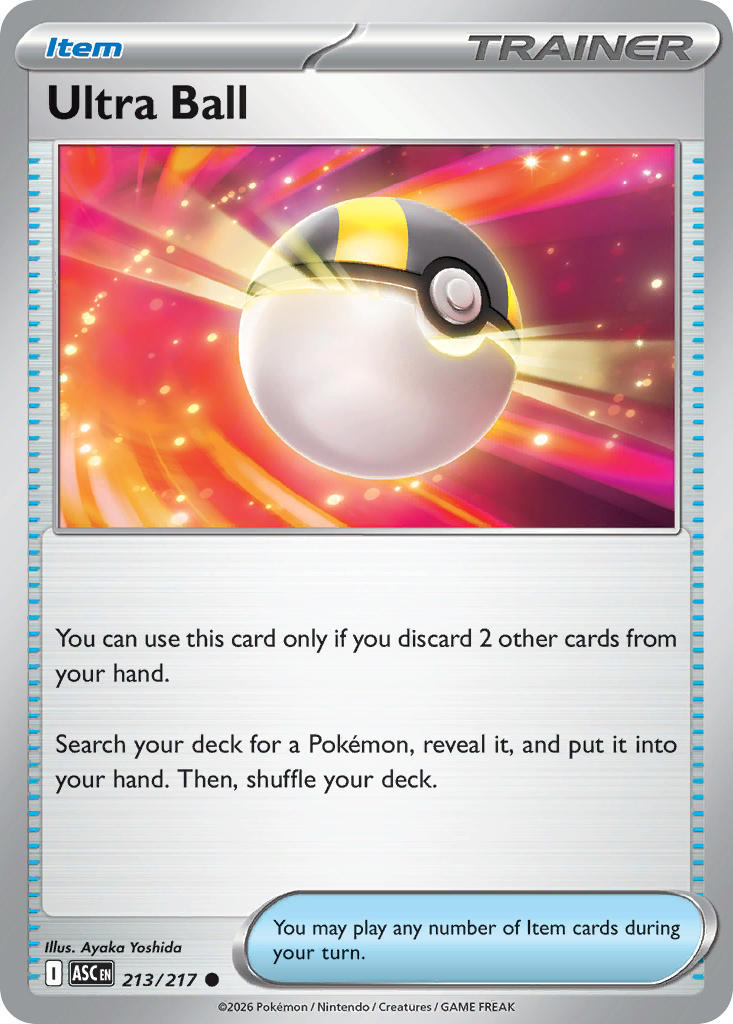
Even a “boring” Common card like Ultra Ball above is worth knowing early — cards like this are deck staples that show up in nearly every competitive Standard deck, and they’re a good reminder that value in this game isn’t only about rare pulls. A $0.25 Common can matter more to your win rate than a $40 alt-art.
The catch: ETB prices have crept up. MSRP is technically $49.99, but according to ORB Sports Cards’ 2026 price breakdown and general retail tracking, popular sets routinely sell for $55-65 at big-box retailers within weeks of release because Pokémon products have been chronically under-produced relative to demand since 2021. If you see one sitting at MSRP, that’s a better buy than waiting.
How rarity actually works (read the bottom-right symbol)
Every Pokémon card has a small rarity symbol printed in the bottom corner next to the card number. Learning to read it takes five minutes and saves you from overpaying based on how “shiny” a card looks.
| Symbol | Rarity | What it means |
|---|---|---|
| Black circle | Common | Base-level cards, usually multiple per pack |
| Black diamond | Uncommon | Slightly less common, still low value |
| Black star | Rare (Holo) | Foil rare, one guaranteed per pack |
| Two black stars | Double Rare (ex cards) | Basic-level “ex” Pokémon, stronger and pricier |
| Magenta star | ACE SPEC | Powerful Trainer card — only 1 allowed per deck |
| One gold star | Illustration Rare | Full-art, alternate illustration |
| Two gold stars | Special Illustration Rare (SIR) | Premium full-art, usually a chase card |
| Three gold stars | Hyper Rare | Gold-bordered version of an ex card |
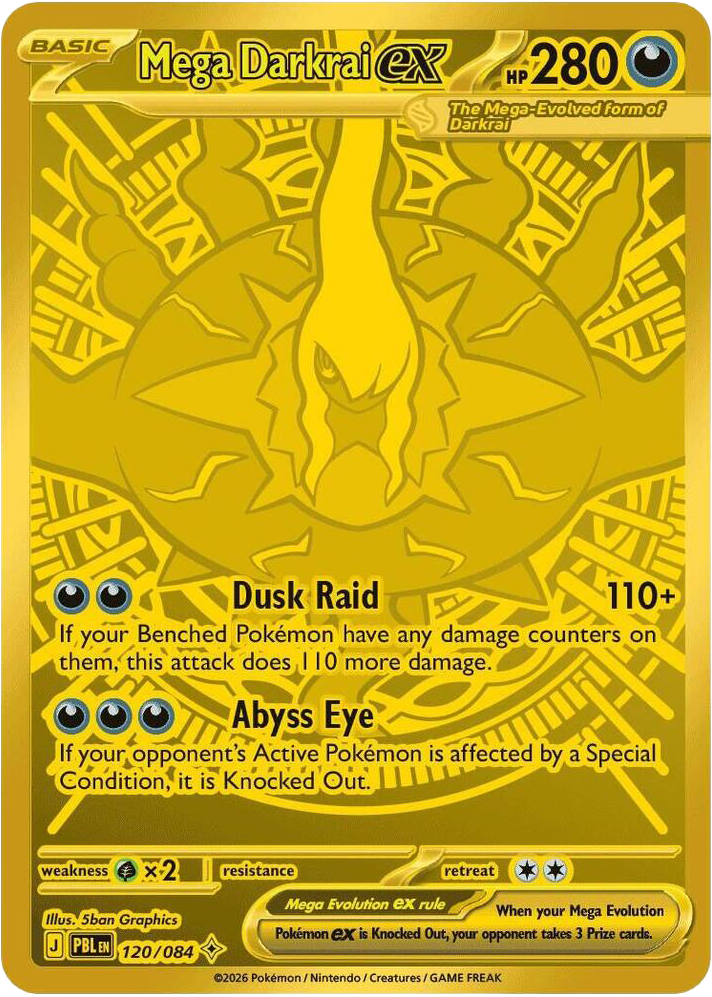
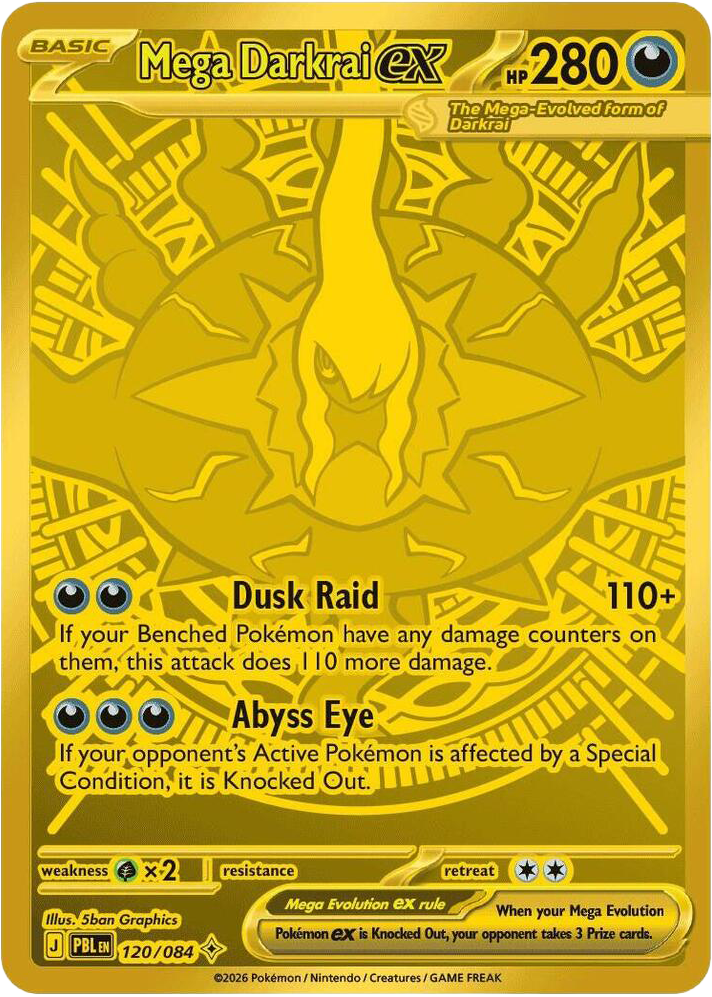
| Gold diamond sparkle | Mega Hyper Rare | Mega Evolution era’s rarest tier, fully gold-embossed |
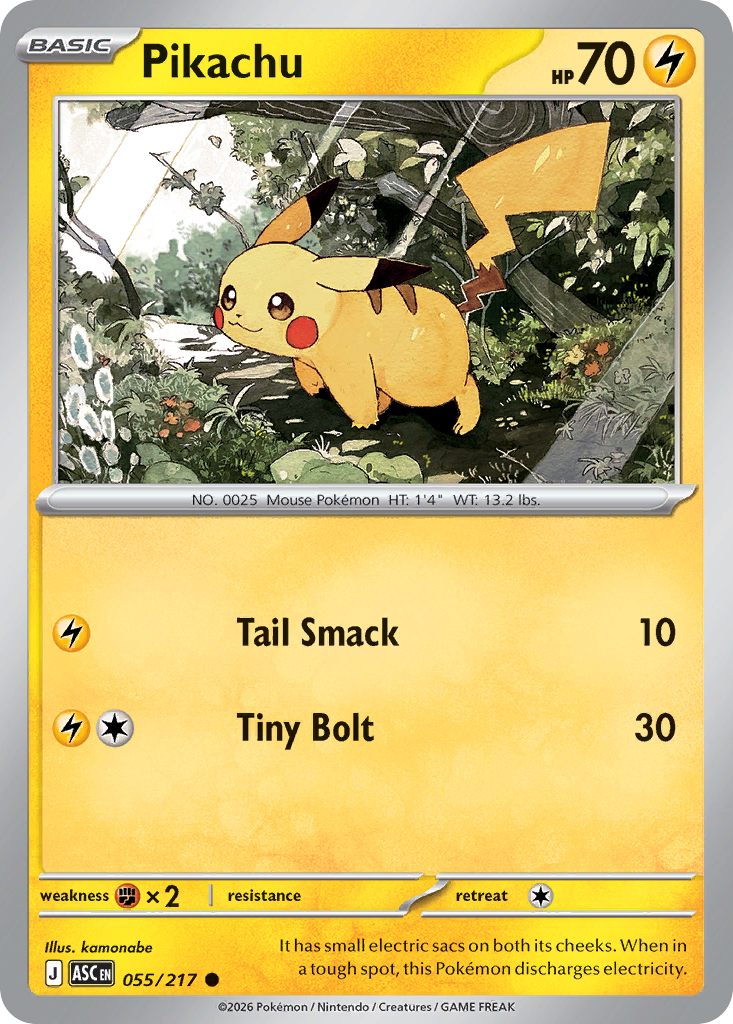
A basic Common Pikachu like this one is worth pennies — but it’s the exact same “Pikachu” name you’ll see reprinted as a $30+ Special Illustration Rare in a different set. The Pokémon’s name tells you nothing about value; the rarity symbol and specific print does. This trips up more beginners than almost anything else — a friend or family member sees “Pikachu” and assumes it’s the valuable one from the news story they half-remember.
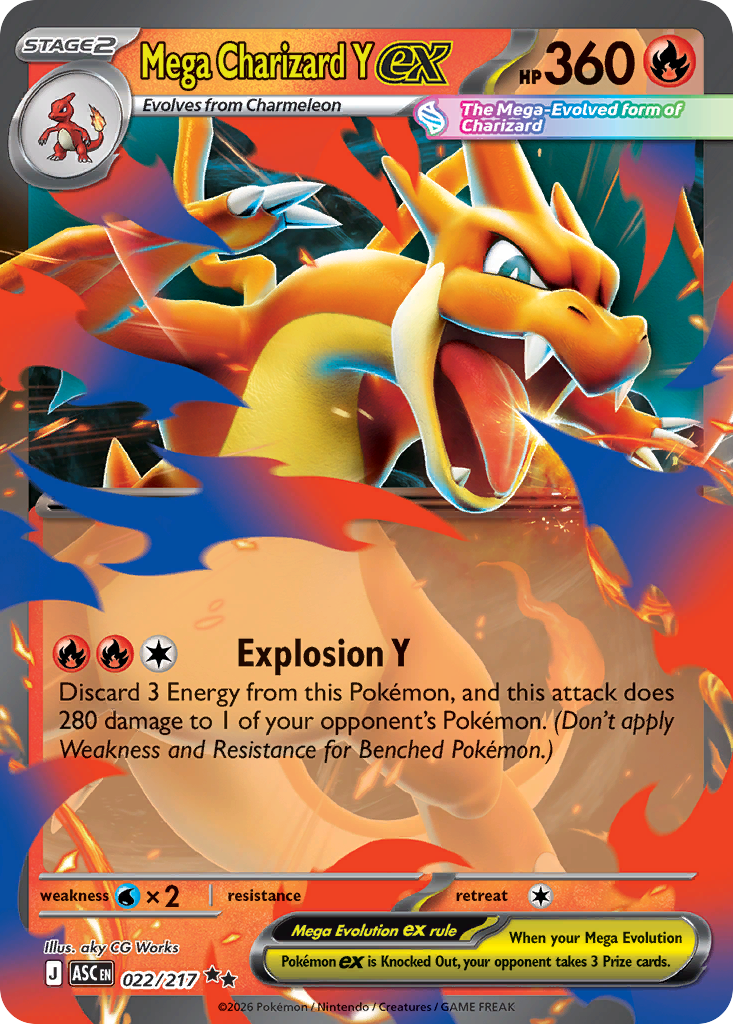
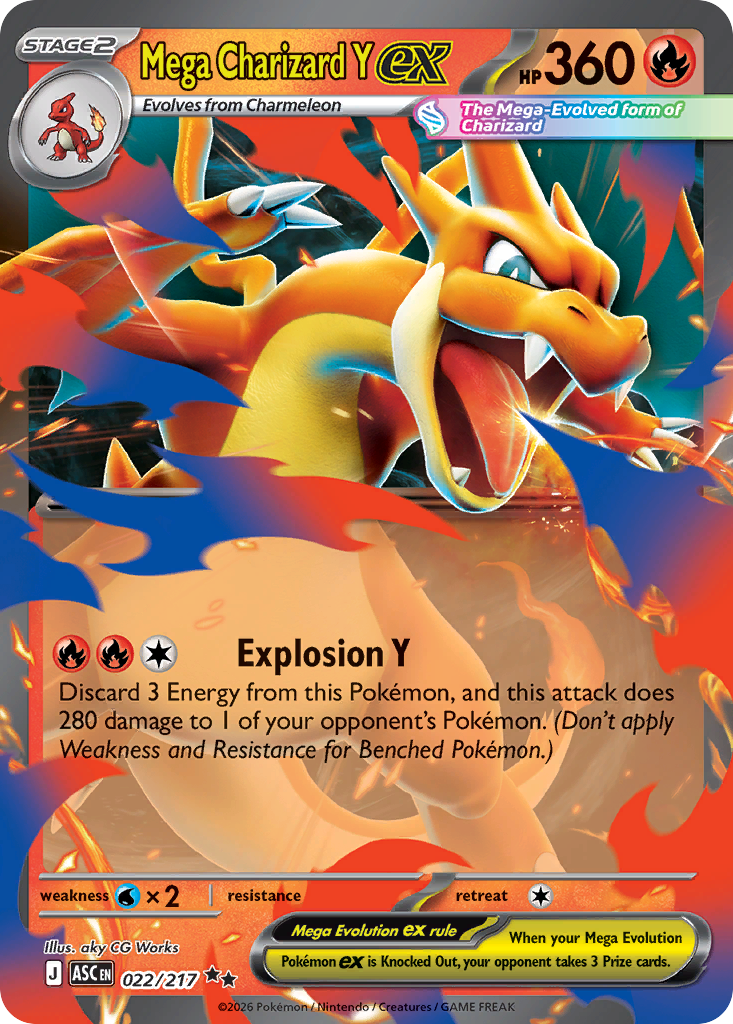
Charizard cards in particular carry a “tax” — because of the character’s long-running popularity, Charizard cards of any given rarity tier tend to sell for noticeably more than an equivalent-rarity card of a less iconic Pokémon. This Mega Charizard Y ex (Double Rare, #22 from Mega Evolution: Ascended Heroes, released January 30, 2026) is a good example — it’s “only” a Double Rare, the second-lowest chase tier, but it still trades well above most other Double Rares from the same set on the secondary market. As of August 2026 it’s been listed in roughly the $8-15 range on TCGplayer depending on condition — worth checking a live price tracker before buying, since card markets move week to week and this is not financial advice.
Understanding rotation: why “Standard legal” matters
If you plan to play in official Pokémon League or tournament events (not just kitchen-table games), you need to understand Standard format rotation. Every card has a small letter — the “regulation mark” — printed near the bottom of the card, next to the illustrator credit. As of the 2026 Standard Format Rotation that took effect April 10, 2026 for in-person Play! Pokémon events (and March 26, 2026 for Pokémon TCG Live), cards with a G regulation mark are no longer legal for Standard play. That rotation knocked out entire sets including the original Scarlet & Violet base set, Paldea Evolved, Obsidian Flames, Paradox Rift, and Scarlet & Violet 151 — all still perfectly playable at home, but not at a sanctioned event.
Currently, regulation marks H, I, and J are Standard legal, covering everything from the start of the Mega Evolution era (Mega Evolution, ME01, September 2025) through the newest releases like Mega Evolution: Pitch Black (July 2026).
Why this matters for beginners specifically: if you’re buying a starter deck to play competitively, check that the cards inside carry a currently-legal regulation mark before you build around it — otherwise you might invest hours learning a deck that can’t be played at your local league night. If you only ever play casually with friends, rotation doesn’t matter at all; that’s the Expanded or “anything goes” way most people actually play.
Common beginner mistakes (and how to avoid them)
1. Buying “investment” cards before you understand the market. Chase cards can lose value fast when a set gets reprinted or a new Charizard/Pikachu card releases and splits collector attention. Buy cards you actually want to own or play with, not because a video told you they’ll “definitely go up.”
2. Trusting eBay listings with no seller history. Counterfeit cards are a real, documented problem — look for sellers with substantial positive feedback, ask for close-up photos of the card’s font and card stock, and be suspicious of a “rare” card being sold in bulk quantities by the same account, which is a common red flag according to Dexerto’s counterfeit guide. If a price looks 40% below every other listing for the same card, that’s a warning sign, not a deal.
3. Not sleeving cards immediately. Bare cards pick up fingerprint oils and edge wear within a single trade session. A $3 pack of penny sleeves plus a $10-15 toploader box for anything you consider a keeper will do more for long-term condition than almost anything else you buy.
4. Cracking a whole booster box hoping to “hit big.” Box odds are set by the manufacturer, not by luck streaks — if a set only has one Mega Hyper Rare printed at roughly 1-in-1,200-pack odds (per set-specific pull-rate breakdowns reported by outlets like PokeBeach), a single 36-pack box is not likely to contain one. Go in expecting Commons, Uncommons, and a handful of Rares/Ultra Rares, with anything bigger as a genuine bonus.
5. Ignoring storage conditions. Direct sunlight fades foil cards over months, and humidity warps cardboard. A binder or box kept out of direct light and away from a damp basement is free insurance.
Budget-friendly ways to start collecting or playing
- Play free first. The Pokémon TCG Live app (and the newer Pokémon TCG Pocket mobile game) let you learn rules and try decks digitally at zero cost before spending on paper cards.
- Buy singles instead of packs for a specific deck. If you want a playable deck, buying the exact 15-20 cards you need as singles from a marketplace is almost always cheaper than gambling on packs to pull them.
- Start with one Battle Deck, not multiple. A single Pikachu ex Battle Deck gives you a complete, legal 60-card deck for well under $20 — plenty to learn the game and play casually with a friend who buys a second one.
- Join a local Pokémon League (free, run through participating game stores) for casual weekly play — you don’t need a “good” deck to attend, and most groups are beginner-friendly by design.
- Buy loose singles of Commons/Uncommons in bulk if you just want a fun binder to flip through — bulk commons often sell for pennies each and still include plenty of recognizable Pokémon.
Should you get cards graded (PSA/CGC) as a beginner?
Not yet, in almost every case. Grading costs $15-50+ per card depending on turnaround speed and service, plus shipping and insurance both ways, and it only makes financial sense on cards already worth well above that in raw condition — think $75+ Special Illustration Rares or Hyper Rares in genuinely pristine, never-touched condition. A beginner’s early pulls are very unlikely to clear that bar. Learn the hobby, build a want-list, and revisit grading once you’ve pulled or bought something that’s both rare and in mint condition — sleeved and toploadered from the moment it came out of the pack, with sharp corners and no whitening on the edges.
FAQ
Do I need to buy a whole booster box to start collecting?
No. A single ETB or even a few loose packs is a better starting point — booster boxes are a bulk decision for people who already know they want that many packs of one specific set.
What does “Standard legal” mean and why should a beginner care?
It means a card’s regulation mark is currently allowed at official Play! Pokémon tournaments. It doesn’t matter for casual home games, but it matters a lot if you plan to play at league nights or events, since rotated cards (currently anything with a “G” mark or earlier) can’t be used there as of the 2026 rotation.
Are old Pokémon cards from the 1990s-2000s worth more than new ones?
Not automatically — condition and rarity matter more than age. A beat-up 1999 Base Set Common is often worth less than a mint modern Special Illustration Rare. Vintage cards from the original Base Set or early expansions can be valuable in top condition, but “old” alone isn’t the deciding factor.
How can I tell if a Pokémon card I’m buying online is real?
Check the font (counterfeit cards often use a slightly wrong typeface), the card stock (real cards have a black layer between the front and back that shows if you tear the edge — don’t do this on a card you’re keeping, but it’s a known authentication trick for cheap bulk cards), and buy from established sellers with verifiable feedback rather than brand-new accounts selling suspiciously cheap rares.
Is it better to buy a booster box or the same number of packs individually?
A sealed booster box usually works out slightly cheaper per pack than buying that many individual packs at retail, but as a beginner you’re better off buying fewer packs first to see if you enjoy the set before committing $140-165 to a box.
The takeaway
Start small: one Battle Deck to learn the rules, one ETB if you want to build a collection, and five minutes spent learning the rarity symbols and regulation marks before you buy anything expensive. Everything past that — booster boxes, singles hunting, grading — is worth exploring once you actually know what you like about the hobby, not before. Card prices and the competitive meta both shift constantly, so treat any price mentioned here as a rough, dated snapshot rather than gospel, and always double-check current listings before buying.
If you want to see what a recent set’s chase cards actually look like and roughly what they’re worth, check out our breakdown of Pokémon TCG Pitch Black’s best pulls and chase cards.
Related Articles
- How to Buy Pokémon Cards Online Safely (2026 Guide)
- How to Build Your First Standard Pokémon TCG Deck
- Pokémon TCG Live Beginner’s Guide: Codes, Decks, Ranked
More Trading Card Game Guides
- How to Buy One Piece Card Game Safely Online (2026) (One Piece Card Game)
- How to Buy Dragon Ball Fusion World Cards Safely (2026) (Dragon Ball Super Card Game)
Comments