※本ページはプロモーションが含まれます
Disclosure: This post contains affiliate links. If you buy through them, we may earn a commission at no additional cost to you. Learn more.
Short answer: Pokémon TCG Pocket is a free-to-download mobile app where you never actually own anything — no resale value, no physical object, just data tied to your account — while the physical Pokémon TCG costs real money up front but gets you cards you can hold, trade, resell, and play in sanctioned tournaments. They’re not really competing for the same dollar. If you’re brand new to Pokémon cards in 2026, Pocket is the cheapest, lowest-risk way to learn how the game actually plays before you spend anything on cardboard. Here’s the full breakdown of what each one offers, what they cost, and whether there’s any real overlap between the two.
- What Is Pokémon TCG Pocket, Exactly?
- What You Get With the Physical Pokémon TCG
- Cost & Pricing Model: Free Packs vs. Real Cardboard
- Do Pokémon TCG Pocket Cards Have Any Real Crossover With Physical Cards?
- Gameplay Differences That Actually Matter
- Downsides Worth Knowing Before You Commit
- Which Should a Newcomer Actually Start With?
- Frequently Asked Questions
- The Takeaway
- Related Articles
- More Trading Card Game Guides
What Is Pokémon TCG Pocket, Exactly?
Pokémon TCG Pocket is a free mobile app (iOS/Android) built by Creatures Inc. and DeNA that launched worldwide on October 30, 2024, after a New Zealand soft launch a month earlier. It’s a stripped-down, digital-only version of the card game — you open virtual booster packs, build 20-card decks, and battle other players or the AI, all inside the app. It’s been a genuine mobile hit: it crossed 200 million downloads by May 2026, and pulled in an estimated $298.2 million in revenue in just the first half of 2026, according to industry trackers.
Every account gets two free pack openings a day at no cost, plus event missions and login rewards that hand out more packs over time. You can play the entire game for $0 if you’re patient. The catch is the same one every gacha-style mobile game has: the cards, currency, and account exist only inside Pokémon’s servers. If the app is ever discontinued (as its predecessor, Pokémon TCG Online, was in 2023), your collection disappears with it. That’s not a hypothetical risk unique to Pocket — it’s just how licensed digital-only games work, and it’s worth knowing going in.
What You Get With the Physical Pokémon TCG
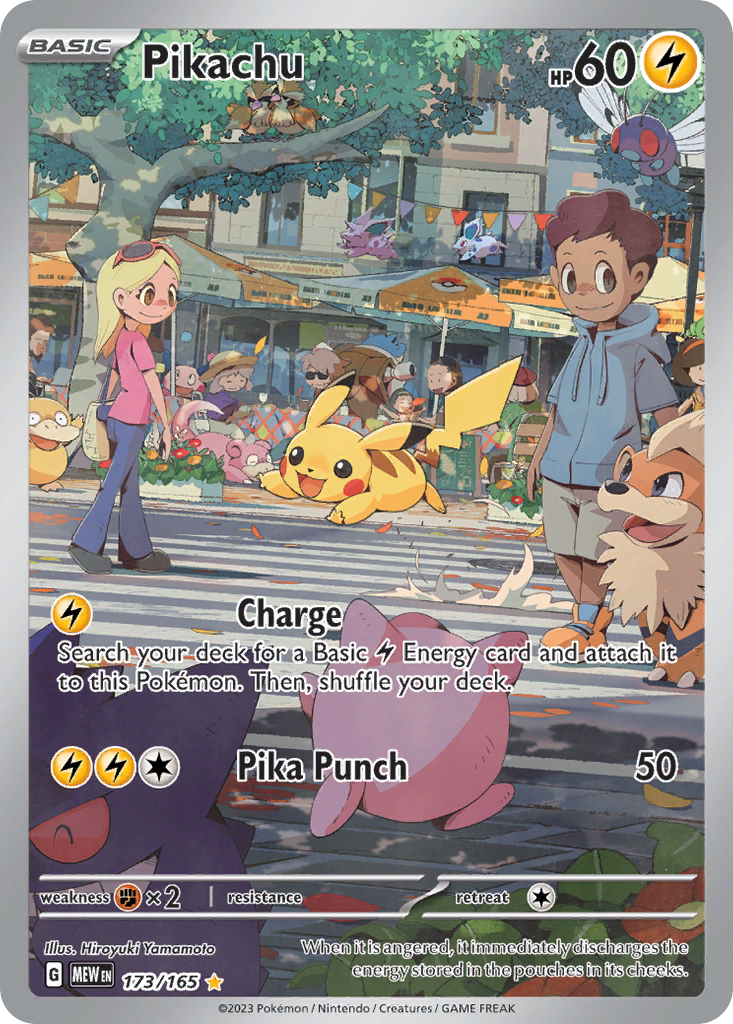
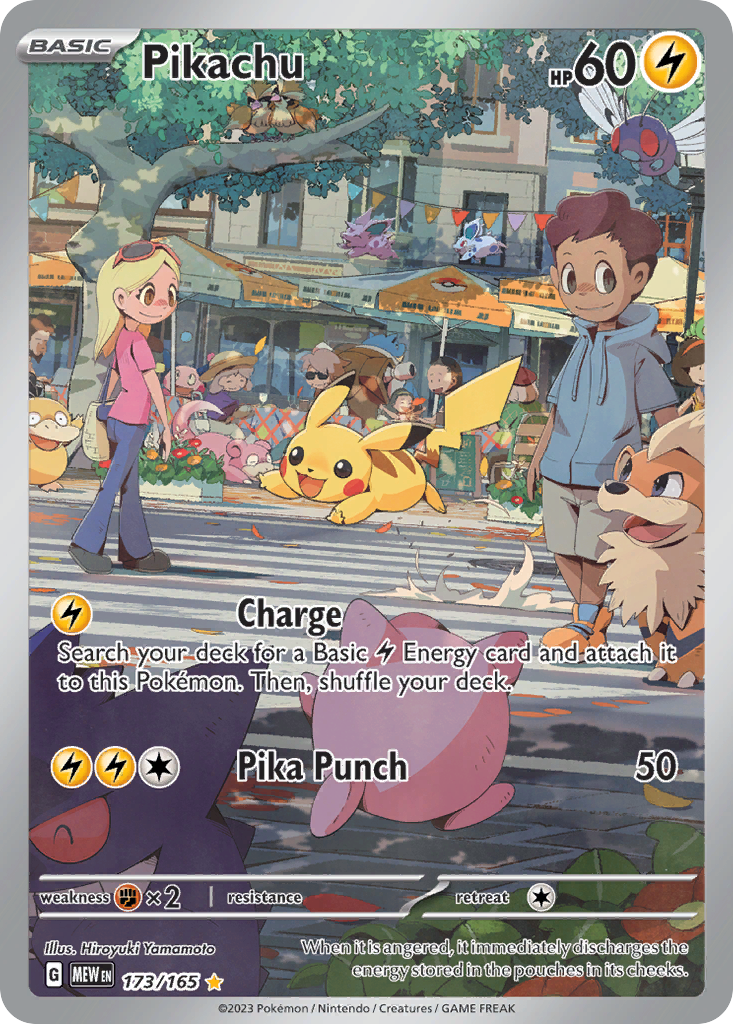
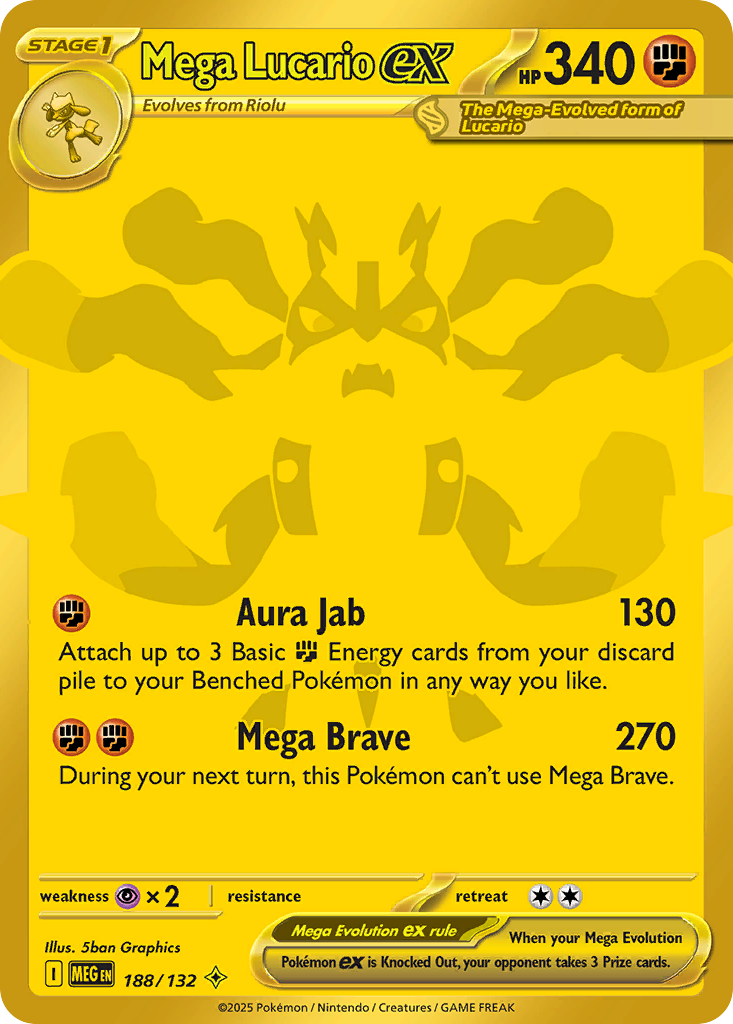
The physical Pokémon TCG is the paper card game that’s existed since 1996 — the one your local game store, Target, and Walmart sell in booster packs, Elite Trainer Boxes, and booster boxes. As of mid-2026, MSRP on a standard booster pack is around $4.49, an Elite Trainer Box (ETB) runs about $49.99, and a sealed booster box (36 packs) lists around $161. In practice, high-demand sets like Prismatic Evolutions or the current Mega Evolution era often sell well above MSRP at retail because of scalping and short print runs, so real-world prices can run noticeably higher than sticker price — something to budget for before you go shopping.
What you’re actually buying is permanent: a physical Pikachu ex Illustration Rare like the one above (from the Pokémon 151 set, sv3pt5-173) is yours to keep, sleeve, grade, trade, or resell on TCGplayer or eBay whenever you want. That’s the core trade-off versus Pocket — you’re paying more up front, but what you get has real, tracked market value and doesn’t depend on a server staying online.
Cost & Pricing Model: Free Packs vs. Real Cardboard
| Pokémon TCG Pocket | Physical Pokémon TCG | |
|---|---|---|
| Entry cost | Free (2 packs/day) | ~$4.49 per pack, ~$50 ETB, ~$161 booster box |
| Optional subscription | Premium Pass, $9.99/month (1 extra pack/day + missions) | None — one-time purchases only |
| What you own | Nothing transferable; account-locked digital cards | Physical cards with real resale/market value |
| Resale possible? | No | Yes (TCGplayer, eBay, local shops, grading services) |
| Risk if service ends | Total loss of collection | None — cards remain yours |
| Tournament legality | Pocket-exclusive online events only | Play! Pokémon sanctioned events (Regionals, Worlds) |
Prices as of August 2026 and subject to change — this isn’t financial or investment advice, just a snapshot for planning purposes.
Do Pokémon TCG Pocket Cards Have Any Real Crossover With Physical Cards?
Practically none, and it’s a common point of confusion for newcomers. A few things to know:
- Redemption codes don’t cross over. Physical booster packs and ETBs include code cards, but those codes are for Pokémon TCG Live (the free desktop/mobile client for playing with digital versions of your actual physical cards), not Pokémon TCG Pocket. The two apps use entirely separate gift-code systems, and Pokémon Support has confirmed a Live code simply won’t validate on the Pocket redemption site.
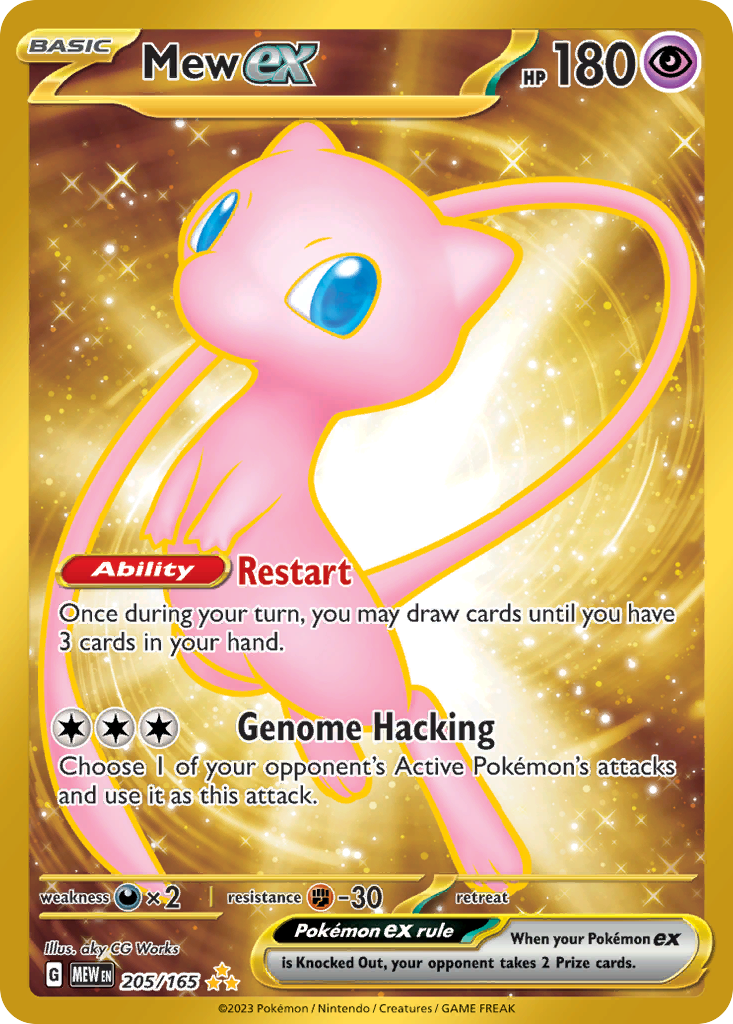
- The rarity systems don’t match up. Pocket has its own tiers — Crown Rare and Immersive Rare, both digital-only — that don’t exist in the physical game at all. Physical exclusives like Special Illustration Rare and Hyper Rare (the Mew ex above, sv3pt5-205, is a physical Hyper Rare from 151) don’t exist in Pocket either. A “rare” pull in one game has no equivalent card in the other.
- Themed releases now line up, but the cards themselves don’t. In July 2026, Pokémon Japan did something new: it revealed the physical Storm Emeralda set (releasing as Mega Evolution: Delta Reign in English on November 6, 2026) alongside Pocket’s Ruler of the Skies expansion (which launched July 30, 2026), with both spotlighting a Mega Rayquaza ex. It’s the first time a Pocket expansion and a physical set launched around the same marketing beat. But they’re still separate products with separate artwork — you can’t pull a card in one game and use or trade it in the other.
So the crossover is thematic and promotional, not functional. If you’re hoping your Pocket collection will someday convert into real cards (or vice versa), it won’t — treat them as two separate hobbies that happen to share characters.
Gameplay Differences That Actually Matter
Beyond cost and ownership, the two games play noticeably differently:
- Deck size: Pocket decks are a fixed 20 cards (max 2 copies of any named card); physical decks are 60 cards.
- Energy: Pocket has no Energy cards at all — an automatic “Energy Zone” hands you one Energy per turn to attach anywhere. Physical decks require you to draw and manage actual Energy cards.
- Bench size: Pocket caps your bench at 3 Pokémon; physical allows up to 5.
- Starting hand: Pocket deals 5 cards to start; physical deals 7.
- Resistances: Pocket drops the Resistance mechanic entirely to speed games up; physical keeps it.
- Match length: A Pocket match typically wraps in 3-5 minutes. A physical match at a local tournament can easily run 20-30 minutes per game.
Pocket was clearly designed to be a faster, more casual on-ramp, and it succeeds at that — but if you get into competitive physical play later, you’ll be relearning several core mechanics (Energy management, bigger bench, Special Conditions and other rules Pocket simplifies away) essentially from scratch.
Downsides Worth Knowing Before You Commit
Pokémon TCG Pocket:
– Spending is entirely gacha-style — you’re paying for a chance at a card, not a specific card, and $9.99/month for the Premium Pass adds up over a year ($120) for a collection you never truly own.
– No resale outlet exists if you lose interest — unlike a physical binder you could sell off, a Pocket account has zero cash value.
– Pull rates for the best cards are genuinely brutal: a “God Pack” (guaranteed high-rarity pull) hits at roughly 1-in-2,000 pack odds, and top Immersive Rares individually sit well under 1% per pack.
Physical Pokémon TCG:
– Higher entry cost, and chase cards from hyped sets (the current Mega Evolution era included) can sell for hundreds of dollars — plenty of room to overspend chasing a specific pull.
– Counterfeit risk is real when buying single cards online, especially for expensive Special Illustration Rares; stick to reputable marketplaces or your local shop. For more on spotting fakes, see How to Buy Pokémon Cards Online Safely (2026 Guide).
– Standard-format rotation retires older sets from tournament legality every year, so cards bought purely for competitive play can lose relevance even if they hold collector value.
Which Should a Newcomer Actually Start With?
If your goal is just to learn how Pokémon TCG combat works — type matchups, evolving Pokémon, attaching Energy, attacking — start with Pokémon TCG Pocket. It’s free, matches are short, and you’ll get a feel for deckbuilding logic without spending a cent. Most players who go on to buy physical cards say Pocket is what got them curious in the first place.
If your goal is collecting, trading with friends in person, or eventually playing at a local game store or Regional, move to physical sooner rather than later — a Pokémon TCG Battle Academy or a single Pikachu ex Battle Deck is a cheap, structured way in, and it teaches the real 60-card rules Pocket skips. Our full Pokémon TCG Beginner’s Guide 2026: What to Buy First covers exactly what to buy first and what mistakes to avoid.
Realistically, most enthusiasts in 2026 do both: Pocket for a quick match on the train, physical for collecting and real games with friends. They’re complementary hobbies wearing the same branding, not substitutes for each other.
Frequently Asked Questions
Can I use my Pokémon TCG Pocket cards in the physical game, or vice versa?
No. There’s no conversion system in either direction. Pocket cards exist only inside the app, and physical cards can only be redeemed digitally through Pokémon TCG Live (a separate app), never through Pocket.
Is Pokémon TCG Pocket worth spending real money on?
It can be fun if you enjoy collecting for its own sake, but understand you’re buying a chance at a digital card with zero resale value, not the card itself. Most players get a satisfying experience from the free daily packs alone; the Premium Pass ($9.99/month) mainly speeds up collection progress rather than unlocking anything essential.
Does Pokémon TCG Pocket count for official tournaments?
No. Play! Pokémon sanctioned events — Regionals, Special Events, and the World Championships — are physical-TCG only. Pocket has its own in-app competitive events, but they carry no Play! Pokémon ranking or prize support.
Are physical Pokémon cards a good investment?
Some chase cards (like early Special Illustration Rares) have appreciated significantly, but card values fluctuate and can also drop — reprints, rotation, and shifting collector demand all affect price. Treat any card purchase as a hobby expense first; this isn’t financial advice, and past price trends don’t guarantee future returns.
What’s the difference between Pokémon TCG Live and Pokémon TCG Pocket?
Pokémon TCG Live is the free digital client tied to your actual physical card collection (via redemption codes packed with real products) and plays by the full 60-card physical ruleset. Pokémon TCG Pocket is a separate, self-contained mobile game with its own economy, its own simplified 20-card rules, and no connection to physical cards at all.
The Takeaway
Pokémon TCG Pocket and the physical Pokémon TCG are both worth your time, but they’re solving different problems — Pocket is a free, fast, low-commitment way to enjoy the game digitally, while physical cards are a real, resellable hobby with actual competitive stakes. Don’t expect one to feed the other: no codes, no card transfers, and completely separate rarity systems. If you’re just starting out, try Pocket first since it costs nothing, then graduate to a physical starter deck once you know you’re hooked.
Related Articles
- Your First Pokémon TCG League Challenge: What to Know
- Pokémon TCG Beginner’s Guide 2026: What to Buy First
- 2026 Pokémon TCG World Championships Preview
More Trading Card Game Guides
- Naruto Card Game Preorder Guide 2026: What to Know Now (Naruto Card Game)
- Dragon Ball Fusion World vs Pokémon vs One Piece TCG: The Real Comparison (Dragon Ball Super Card Game)
- One Piece Card Game vs. Pokemon vs. Dragon Ball TCG (2026) (One Piece Card Game)
Comments