※本ページはプロモーションが含まれます
If you’re getting into vintage Pokémon cards in 2026, here’s the short version: a raw, near-mint Unlimited Base Set Charizard runs roughly $300–$900, a Shadowless copy jumps to $1,000–$3,000+, and true 1st Edition copies start around $3,000–$6,000 raw and climb into six figures once professionally graded. Print run (1st Edition vs. Shadowless vs. Unlimited), centering, and grade are what actually move the needle — not just “it’s old.” This guide walks through the cards worth knowing from the Wizards of the Coast (WOTC) era — Base Set, Jungle, Fossil, Team Rocket, and the Gym/Neo sets that followed — plus what really drives value today and what a beginner should realistically expect to pay.
- Why “WOTC era” still matters in 2026
- Base Set (1999): the one everyone recognizes
- Shadowless vs. 1st Edition vs. Unlimited: how to actually tell them apart
- Jungle (1999): the “second set” with a real chase card
- Fossil (1999): Gengar is the sleeper chase card
- Team Rocket (2000): the underrated 1st Edition sleeper
- Beyond the “big four”: Gym and Neo sets worth a mention
- Vintage price expectations at a glance
- What actually drives vintage card value in 2026
- FAQ
- The takeaway
- Related Articles
- More Trading Card Game Guides
Why “WOTC era” still matters in 2026
Wizards of the Coast held the English Pokémon TCG license from Base Set’s release on January 9, 1999, through the end of 2003, before The Pokémon Company took printing in-house starting with the EX series. That five-year run — Base Set, Jungle, Fossil, Team Rocket, Gym Heroes, Gym Challenge, the four Neo sets, Southern Islands, Legendary Collection, and the e-Reader trilogy (Expedition, Aquapolis, Skyridge) — is what most collectors mean by “vintage.” Pokémon’s 30th anniversary push in 2026 has kept demand for this era hot, with several benchmark vintage cards up double digits percentage-wise over the past year according to price-tracking sites like PriceCharting and PokemonPriceTracker. That’s a real market signal, but it also means prices swing fast in both directions — treat every number below as a snapshot, not a guarantee.
This isn’t financial advice. Card prices are volatile, thinly traded at the high end (a single big auction result can move “market price” overnight), and past appreciation doesn’t guarantee future returns. Buy vintage cards because you want to own a piece of TCG history first, and treat any upside as a bonus.
Base Set (1999): the one everyone recognizes
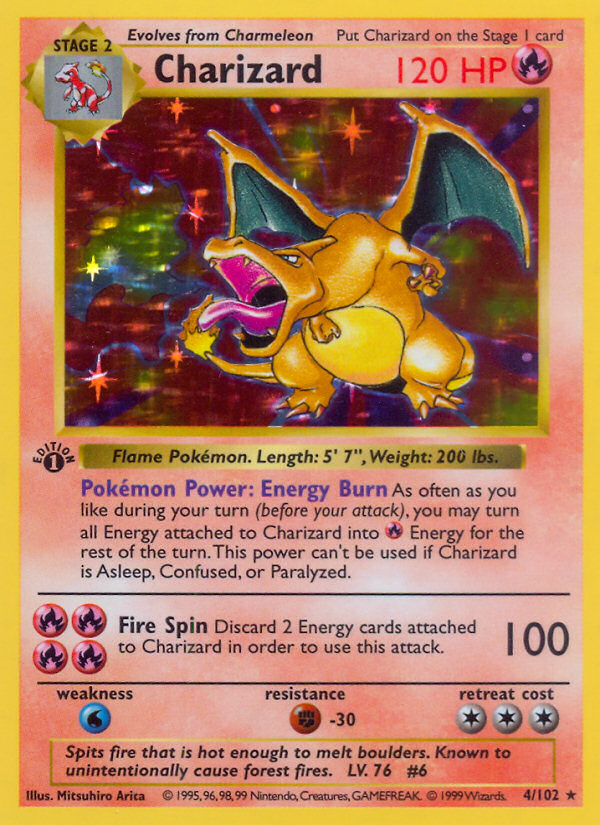
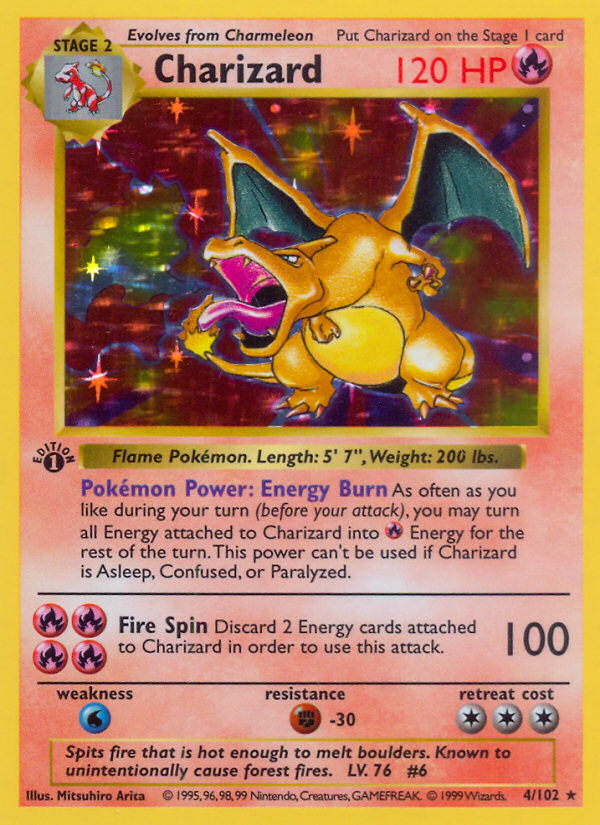
Base Set is the 102-card set that started it all, released in the US on January 9, 1999. Sixteen cards got the Rare Holo treatment, and the print run split into three visually distinct variants over the set’s life — more on that below. The chase card, unsurprisingly, is Charizard (#4/102). As of August 2026, TCGplayer market pricing for a raw, ungraded Unlimited-print Charizard sits around $818 (with recent sales ranging roughly $475–$4,590 depending on condition and listing), while Shadowless raw copies trade in the $1,000–$3,000+ range and true 1st Edition raw copies start around $3,000–$6,000 and go up fast from there. PSA 10 graded 1st Edition Charizards have sold for well into six figures — a PSA 10 reportedly hammered for $550,000 at a Heritage Auctions sale in December 2025 — while PSA 10 Shadowless copies trade closer to $15,000–$25,000. If a raw Unlimited copy in that price range fits your budget better, Charizard Base Set Unlimited Holo is the realistic entry point most beginners actually buy first.
Charizard gets all the attention, but Blastoise (#2) and Venusaur (#15) — the other two starter evolutions — are the more attainable “complete the trio” cards, with Unlimited raw copies currently running roughly $150–$230 and $100–$170 respectively per TCGplayer market data.
The downside: Base Set has been reprinted more than any other set in the game’s history (Base Set 2 in 2000, Base Set Shadowless reprints via Legendary Collection artwork, and countless later Charizard reprints across 25th Anniversary, Celebrations, and other sets). None of those reprints touch original 1999 Base Set value directly, but they do mean “Charizard” alone isn’t a scarcity story anymore — it’s specifically the 1999 print run and its variant that carries the premium.
Shadowless vs. 1st Edition vs. Unlimited: how to actually tell them apart
This trips up almost every new vintage buyer, so it’s worth being precise:
- 1st Edition — Look for a black “Edition 1” stamp on the left side of the card, just below the art window. This was the very first print run (January 1999) and is the smallest of the three by volume.
- Shadowless — No edition stamp, but check the right/bottom edge of the artwork box: Shadowless cards have a flat border with no drop shadow. The copyright line reads “©1995, 96, 98, 99” and the HP/attack-name font is thin. This was the second print run.
- Unlimited (Shadowed) — No stamp, and there IS a visible gray drop shadow to the right of the artwork box, making the card look slightly “raised.” Font on HP and attack names is noticeably bolder/heavier. This was the third-and-later print run and is by far the most common — most loose Base Set cards you’ll find today are Unlimited.
A quick gut check: 1st Edition and Shadowless share the thin font, but only 1st Edition has the stamp; Shadowless and Unlimited both lack the stamp, but only Unlimited has the drop shadow. Jungle and Fossil use a simpler two-tier system (1st Edition stamp present or not — there’s no shadowless variant for those sets), so the stamp alone tells the whole story there.
Caveat for beginners: because 1st Edition and Shadowless command such a premium over Unlimited, they’re also the most commonly faked or misrepresented online — a reprint or an Unlimited card can be dishonestly listed as “shadowless?” with a question mark to dodge liability. If you’re paying vintage prices, buy from a seller who shows clear, well-lit photos of the actual card edges and corners, or buy pre-graded.
Jungle (1999): the “second set” with a real chase card
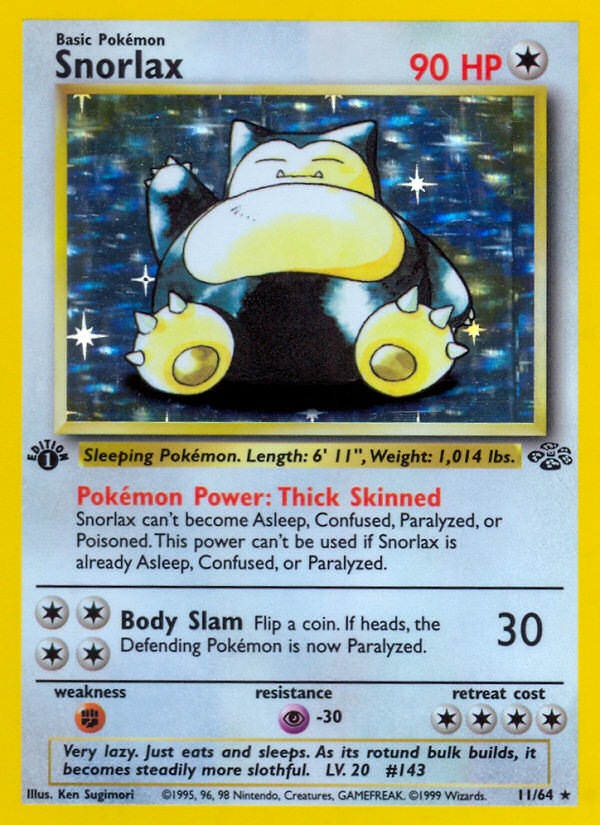
Jungle released June 16, 1999, with 64 cards and 16 holo rares, largely featuring jungle/forest-themed Pokémon. It’s often dismissed as a “filler” set between Base Set and Fossil, but Snorlax (#11) is a legitimately strong chase card — 1st Edition Holofoil market price is around $342, versus roughly $152 for Unlimited, per current TCGplayer data. Jolteon (#4) and Flareon (#3), two of the three Eeveelutions in the set (Vaporeon is oddly the cheapest of the three despite being just as iconic, currently trading below the others), round out the more sought-after holos. Snorlax Jungle Holo Rare is a good example of an affordable, genuinely important vintage holo for a beginner’s first pickup.
A quirk worth knowing: a large batch of Jungle holo rares was printed without the small “Jungle” set symbol under the artwork due to a printing error. It doesn’t reduce legality or grade eligibility, but it’s a fun bit of set trivia that comes up a lot in collector forums.
The downside: outside of Snorlax and the Eeveelutions, most Jungle holos (Kangaskhan, Pidgeot, Wigglytuff) sit in the $20–$60 unlimited range — genuinely affordable, but not the kind of set that appreciates dramatically on its own. If you’re building a set for nostalgia, Jungle is a great budget-friendly vintage entry point rather than an investment play.
Fossil (1999): Gengar is the sleeper chase card
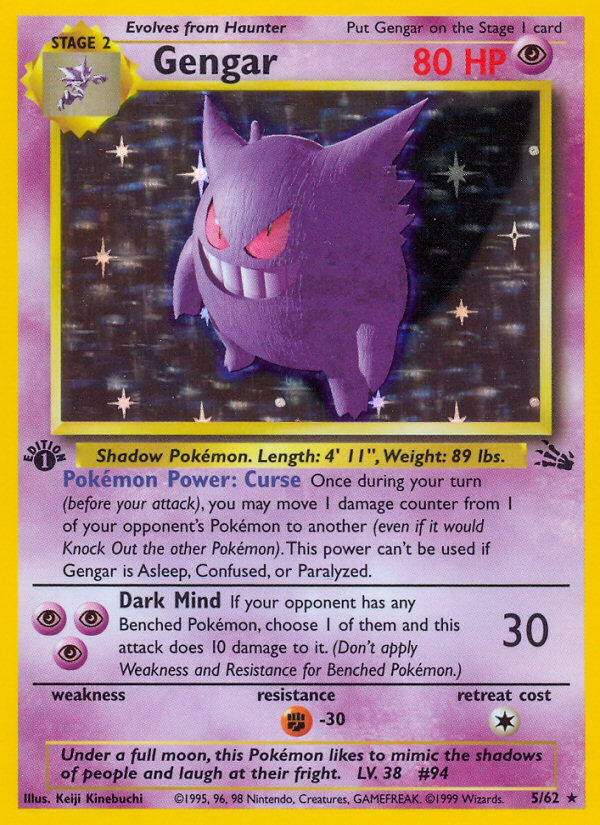
Fossil released October 10, 1999, leaning into ancient/prehistoric and Ghost-type Pokémon, with 62 cards and 15 holo rares. The headline card isn’t the obvious pick — it’s Gengar (#5), currently the most valuable Fossil holo at roughly $601 (1st Edition) / $211 (Unlimited) market price, edging out even Dragonite (#4) at around $462/$187. Ghost-type popularity and Gengar’s enduring status as a fan-favorite Pokémon (it’s had multiple Mega and ex reprints in modern sets) keep demand steady for the original. Gengar Fossil Holo Rare regularly shows up in vintage lots and single-card listings well under $300 raw.
Fossil also reprinted Zapdos — but it’s a completely different card from Base Set’s Zapdos (different attacks, different art angle, different set symbol), a common point of confusion for new collectors searching “Zapdos Pokemon card value” and finding two very different price ranges.
The downside: like Jungle, Fossil’s overall power-price ceiling is lower than Base Set’s. Most of its holos (Aerodactyl, Haunter, Kabutops, Hitmonlee) sit under $100 raw, which makes the set approachable but means it’s unlikely to be your best “grail” purchase if pure appreciation is the goal.
Team Rocket (2000): the underrated 1st Edition sleeper
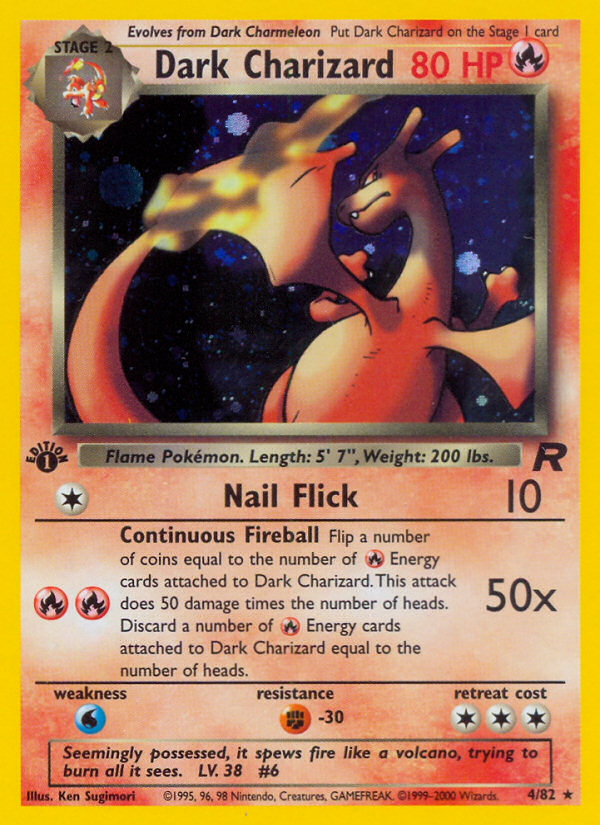
Team Rocket, released April 24, 2000, was the first set to introduce “Dark” Pokémon — villain-aligned evolutions themed around the Team Rocket organization. Dark Charizard (#4) is the clear chase card, currently around $399 (1st Edition) and $370 (Unlimited) market price — notice how close those two numbers are compared to Base Set, where 1st Edition typically commands 3–10x Unlimited. That’s because Team Rocket’s 1st Edition print run, while still real and stamped the same way, wasn’t dramatically smaller than its Unlimited run relative to demand, so the premium compresses. Dark Blastoise (#3) and Dark Dragonite (#5) follow behind Dark Charizard in value. Dark Charizard Team Rocket Holo is worth tracking if you want a second vintage Charizard variant without Base Set 1st Edition money.
Team Rocket is worth knowing specifically because a lot of newer collectors skip straight from Base Set to modern sets and never learn this one existed — it’s a legitimately important, thematically distinct WOTC set with its own scarcity quirks.
The downside: Team Rocket holo foiling from this era is notoriously prone to scratching and peeling compared to Base Set/Jungle/Fossil stock, so raw near-mint copies can be harder to find than the print numbers alone suggest. Inspect surface condition closely before buying raw.
Beyond the “big four”: Gym and Neo sets worth a mention
The Gym series (Gym Heroes, August 2000; Gym Challenge, October 2000) introduced Gym Leader-owned Pokémon, and Blaine’s Charizard (Gym Challenge #2) is arguably the second-most-recognizable vintage Charizard after Base Set’s — currently around $700 (1st Edition) / $594 (Unlimited) market price. The Neo series that followed (Neo Genesis, December 2000, onward) introduced Generation II Pokémon to the TCG for the first time, headlined by Lugia (Neo Genesis #9), whose 1st Edition Holofoil currently trades around $1,300 market price with individual sales reported well above that at the high end — a reminder that vintage 1st Edition pricing gets thin and volatile the further you get from Base Set.
Vintage price expectations at a glance
Approximate raw (ungraded, near-mint) market prices as of August 2026, sourced from TCGplayer market data via the Pokémon TCG API and cross-checked against PriceCharting/PokemonPriceTracker listings. Treat these as ballpark ranges, not appraisals — vintage cards are thinly traded and centering/surface condition swings price significantly within a grade.
| Card | Set (Year) | Variant | Approx. Raw Market Price |
|---|---|---|---|
| Charizard #4 | Base Set (1999) | Unlimited | ~$475–$900 |
| Charizard #4 | Base Set (1999) | Shadowless | ~$1,000–$3,000+ |
| Charizard #4 | Base Set (1999) | 1st Edition | ~$3,000–$6,000+ |
| Blastoise #2 | Base Set (1999) | Unlimited | ~$150–$230 |
| Snorlax #11 | Jungle (1999) | Unlimited / 1st Ed. | ~$150 / ~$340 |
| Gengar #5 | Fossil (1999) | Unlimited / 1st Ed. | ~$210 / ~$600 |
| Dark Charizard #4 | Team Rocket (2000) | Unlimited / 1st Ed. | ~$370 / ~$400 |
| Blaine’s Charizard #2 | Gym Challenge (2000) | Unlimited / 1st Ed. | ~$590 / ~$700 |
| Lugia #9 | Neo Genesis (2000) | Unlimited / 1st Ed. | ~$520 / ~$1,300 |
PSA 9/10 graded copies of any of the above trade at a substantial multiple over raw — often 5–10x for common holos and dramatically more for Base Set Charizard specifically. Grading a vintage card only makes financial sense once its raw value clears roughly double the grading fee; see our PSA vs. CGC vs. BGS: Pokémon Card Grading Guide for turnaround times and current pricing across services.
What actually drives vintage card value in 2026
- Print variant, not just age. As shown above, the exact same artwork can be worth 3–10x more or less depending on whether it’s 1st Edition, Shadowless, or Unlimited. Age alone isn’t the story.
- Centering and surface, disproportionately. Vintage cards were printed on less precise equipment than modern cards, so true 60/40-or-better centering is rare and commands a real premium — it’s often the single biggest swing factor between a PSA 8 and a PSA 10 of the same card.
- Character recognizability. Charizard, Lugia, Gengar, and the three starters consistently outperform mechanically similar cards from the same sets (compare Gengar’s ~$600 1st Edition price to Hypno’s ~$72 from the same Fossil set) — nostalgia and brand recognition are doing real work in the pricing.
- Grading population. PSA’s population reports show far fewer Gem Mint 10s exist for early WOTC holo cards than for modern cards, because 1999-era printing and handling standards were looser — that scarcity at the top grade is a major price driver independent of the card’s raw supply.
- General collector sentiment. The 2026 30th-anniversary attention on the franchise has pulled buyers back toward “the classics,” which has lifted vintage prices across the board — but sentiment-driven gains can also cool off quickly if new-set hype pulls attention elsewhere.
If you’re buying loose vintage singles online rather than at a local card shop, our How to Buy Pokémon Cards Online Safely guide covers red flags for fakes and reputable marketplaces in more depth.
FAQ
Is it worth buying ungraded (raw) vintage cards as a beginner?
It can be, especially for lower-value cards (commons, energies, cheaper holos) where the grading fee would exceed the card’s worth. For anything you suspect could grade PSA 9 or better — sharp corners, centered, no whitening — it’s usually smarter to buy already graded, such as a PSA-Graded Vintage Pokemon Card listing, or to have a trusted local shop inspect a raw copy before you commit, since raw vintage cards are the segment most targeted by counterfeiters.
How can I tell if a vintage card is a fake?
Check the copyright line (should read “©1995, 96, 98, 99 Nintendo, Creatures, GAME FREAK” for Base Set), inspect the holo pattern under light (genuine WOTC-era foil has a fine, consistent sparkle rather than diagonal stripes or an oversaturated shine), and look at print quality up close — genuine cards show a clean rosette dot pattern, while fakes often blur or pixelate. For anything over roughly $100, it’s worth getting a second opinion from a grading service or an experienced local shop before paying.
Does a vintage Charizard need to be graded to be worth money?
No — raw Unlimited copies in decent shape still sell in the hundreds of dollars, and raw 1st Edition/Shadowless copies sell for thousands. Grading adds a documented, trusted condition assessment that unlocks the higher end of the market (especially PSA 9/10), but it costs money and takes time, so it only makes sense once a card’s estimated value clearly justifies the fee.
Are 1999–2003 WOTC cards still legal to play in tournaments?
No. Standard and Expanded tournament formats rotate out old sets, and WOTC-era cards left legal Standard/Expanded play many years ago. They’re purely collector pieces now — the game text on a vintage Charizard hasn’t been tournament-legal in a long time, which is worth knowing if you ever see one marketed with a “still playable” angle.
Where’s the safest place to buy vintage WOTC singles?
Established marketplaces with buyer protection (TCGplayer, eBay with authenticity guarantee on higher-value listings, PSA/CGC-slabbed cards from reputable auction houses) are the safest bet, alongside local card shops you can inspect cards from in person. Avoid unsolicited DM offers and listings with only stock photos rather than photos of the actual card.
The takeaway
Vintage WOTC-era Pokémon cards remain some of the most recognizable collectibles in the hobby, and 2026’s 30th-anniversary attention has only reinforced that. But “vintage” isn’t a single price tier — a Base Set Charizard alone spans roughly $300 to $500,000+ depending purely on print variant and grade, and plenty of genuinely important cards from this era (Snorlax, Gengar, Dark Charizard, Blaine’s Charizard) sit in a much more approachable $150–$700 range. Start by learning to identify 1st Edition, Shadowless, and Unlimited on sight, buy from sellers who show real photos of the actual card, and treat any price talk as a snapshot of a fast-moving market rather than a promise.
Related Articles
- Pokémon Card Value Myths, Debunked (2026 Collector Guide)
- Japanese Pokémon Figures: A Collector’s Guide to Moncolle, Gashapon & ARTFX
More Trading Card Game Guides
- Dragon Ball Fusion World vs Pokémon vs One Piece TCG: The Real Comparison (Dragon Ball Super Card Game)
Comments