※本ページはプロモーションが含まれます
If you’ve ever wondered whether Charizard cards are actually a good long-term hold or just internet hype, the honest answer is: it depends entirely on which Charizard. The 1999 Base Set 1st Edition Holo went from a $3 pack pull to a $550,000 auction result in December 2025, and a Japanese variant blew past $1.7 million in March 2026 — but a 2016 reprint of that same artwork sells for around $100 today, and a 2020 chase card that opened at $500 is now worth less than half that. Charizard’s overall brand is bulletproof; individual Charizard cards are not. Here’s what actually happened to four of the character’s biggest cards, era by era, using real sale data instead of “this card is going to the moon” energy.
Not financial advice. Everything below is a snapshot of what these cards have sold for as of August 2026, sourced from auction houses, TCGplayer, and price-tracking sites. Card prices are volatile, population reports change monthly, and past performance — especially a chart that only goes up — is not a guarantee of anything. Treat this as market history, not a buy signal.
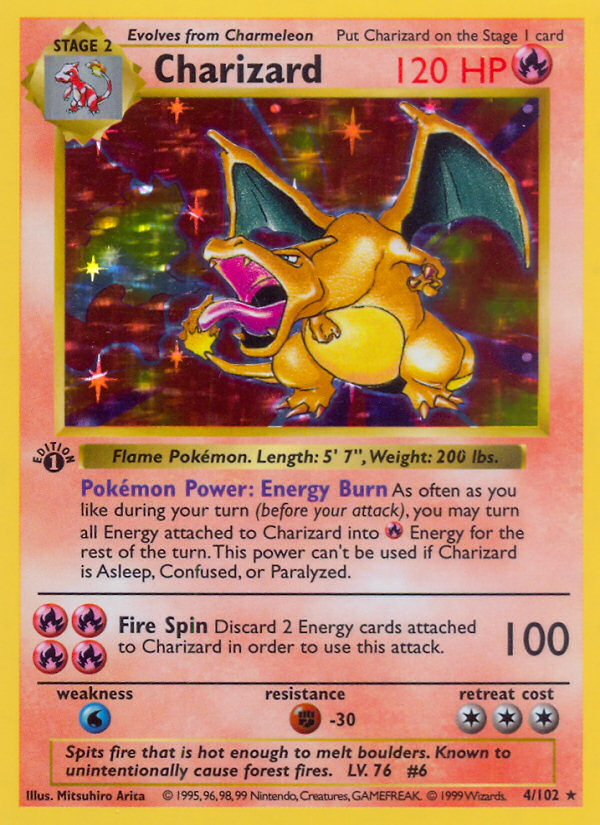
- The Original: 1999 Base Set Charizard (1st Edition Holo, #4/102)
- The Affordable Reprint: XY Evolutions Charizard (2016, #11/108)
- The Modern Hype Cycle: Champion’s Path Charizard VMAX (2020, #74)
- The Current Chase: 151 Charizard ex, Special Illustration Rare (2023, #199/165)
- Charizard Price History at a Glance
- What This Pattern Actually Teaches Collectors
- Is Charizard Still a Good Long-Term Hold in 2026?
- Frequently Asked Questions
- Related Articles
- More Trading Card Game Guides
The Original: 1999 Base Set Charizard (1st Edition Holo, #4/102)
This is the card that built the entire “Pokémon cards are worth money” narrative, and its price history is genuinely wild once you plot it out year by year.
- 1999–2010: Pulled from booster packs that retailed for around $2–4, 1st Edition copies mostly traded hands in played condition for $200–$500 during the early 2000s. Nobody was grading cards yet.
- 2011–2016: A PSA 10 1st Edition copy could be had for roughly $5,000–$15,000 — a long, quiet plateau while the game itself was in a relatively low-hype period in the West.
- 2016–2019: Pokémon Go reignited nostalgia across the whole hobby, and PSA 10 prices climbed from around $15,000 to $30,000–$40,000 by late 2019.
- 2020–2021 (the boom): In December 2020, Logan Paul bought a BGS 10 1st Edition Charizard for a reported $150,000 in a private sale — a moment that got mainstream press coverage and pulled a wave of new money into the hobby. Through 2021, PSA 10 1st Edition sales ranged roughly $200,000–$420,000, with $420,000 standing as the high-water mark for years.
- 2022–2024 (the correction): Like most of the pandemic-era collectibles boom, the market cooled. PSA 10 1st Edition Charizards mostly traded in the $180,000–$300,000 range for two-plus years — a real, multi-year drawdown on “the safest card in the hobby.”
- December 2025: Heritage Auctions sold a PSA 10 1st Edition Charizard for $550,000, breaking the 2022 record and headlining a $5.27 million trading-card-games auction.
- March 2026: A different card — the Japanese Base Set Charizard with no rarity symbol, graded PSA 10 — sold for $1.7 million, becoming the single most expensive Charizard ever sold and the first Charizard card to break $1 million. Five days later, a similar copy with the PSA case signed by original artist Mitsuhiro Arita sold for $1,232,200.
The caveat: PSA has graded roughly 5,325 1st Edition Base Set Charizards, and only about 124 of those have come back a PSA 10 — a tiny fraction. That scarcity is real, but it also means this exact price history doesn’t transfer to a random Charizard you find at a garage sale; a well-loved, off-center copy from the same set might be worth $50–$200. This is also the single most counterfeited and most re-holdered (fake-graded-slab) card in the hobby given the dollar amounts involved, so buying loose 1st Edition Charizards from anyone other than a reputable auction house or established seller carries real fraud risk — see our guide on buying Pokémon cards online safely before you spend five or six figures on one card.
The Affordable Reprint: XY Evolutions Charizard (2016, #11/108)
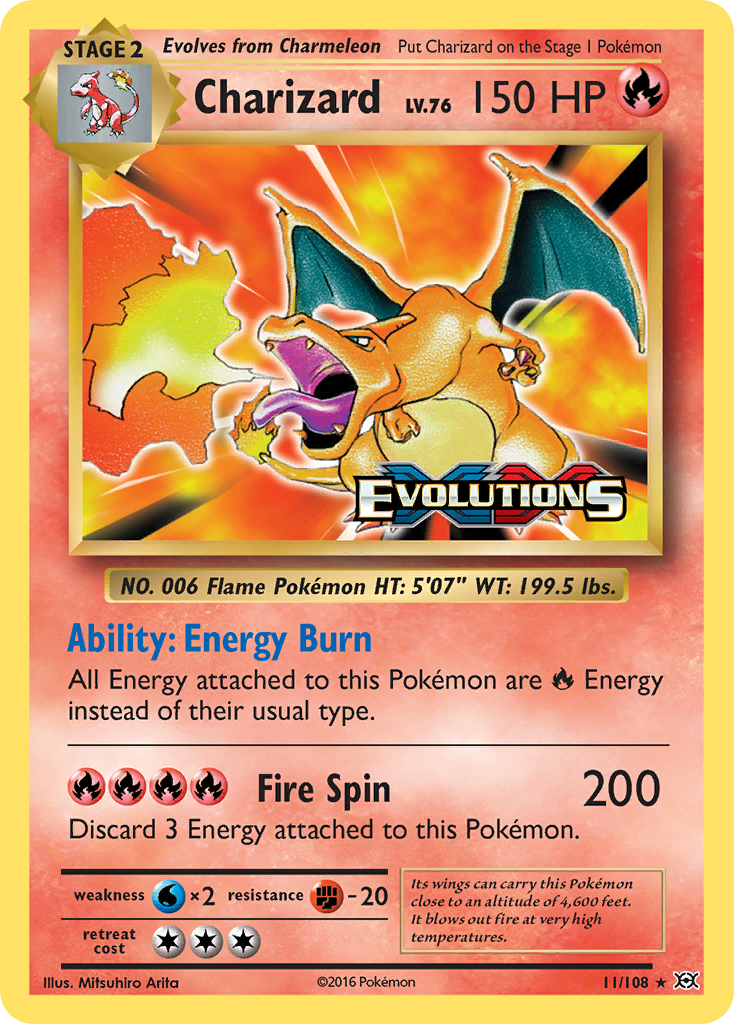
Released November 2, 2016 for Pokémon’s 20th anniversary, Evolutions reprinted the Base Set artwork almost card-for-card, and its Charizard became the go-to “I want a Charizard without spending five figures” pickup for casual collectors — especially after the Logan Paul purchase made the original suddenly feel out of reach in late 2020.
Because it’s a modern print with a much larger and more accessible print run than the 1999 original, its ceiling is a fraction of the vintage card’s: it rode the broader 2020–2021 boom higher along with everything else in the hobby, cooled off through the correction, and has settled into a fairly stable PSA 10 range of roughly $90–$125 as of early 2026 (a January 2026 sale closed at $122.22).
The caveat and the lesson here: same artwork, same character, completely different long-term trajectory. Print run and scarcity — not the picture on the card — are what separate a $122 PSA 10 from a $550,000 one. Anyone buying a modern reprint expecting Base Set–style appreciation is misreading why the original card is valuable in the first place.
The Modern Hype Cycle: Champion’s Path Charizard VMAX (2020, #74)
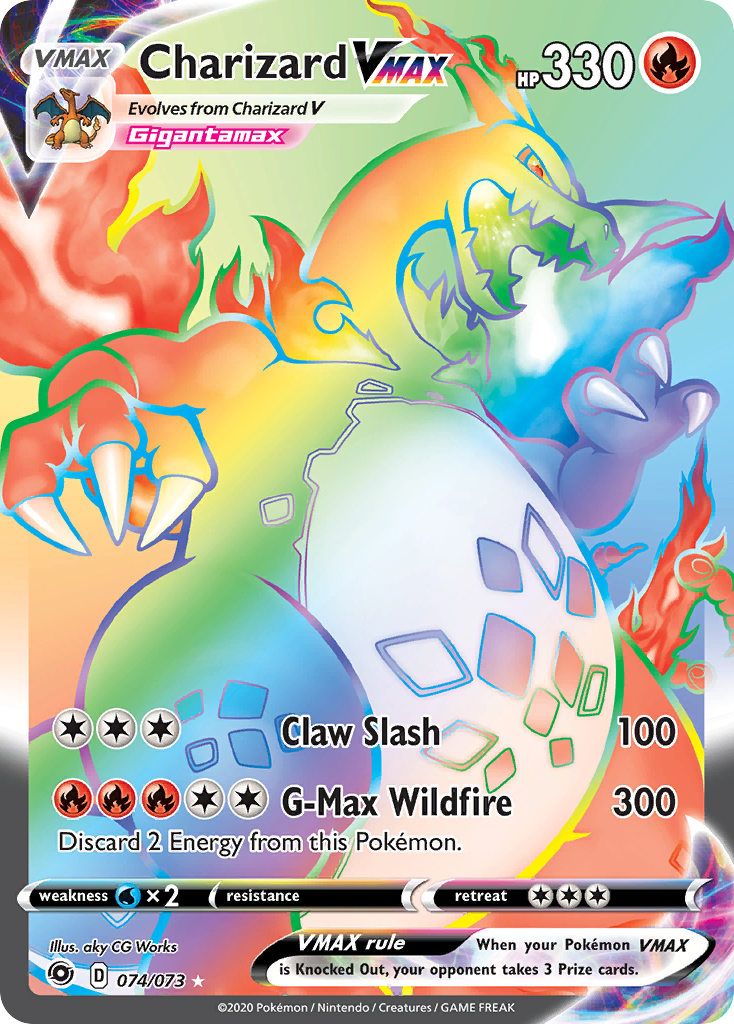
Champion’s Path launched September 25, 2020, right in the middle of the pandemic pack-opening craze, and its Rainbow Rare Charizard VMAX became a poster child for that mania — it was selling for north of $500 in the weeks after release, driven by streamers, box-breaking channels, and a genuine shortage of product on shelves.
That price didn’t hold. By February 2023 it had fallen to around $200. By May 2024, raw copies were trading in the $150–$235 range depending on condition, with a graded PSA 10 fetching close to $400. As of July 2026, TCGplayer’s market price sits around $233 — a card that’s basically flat over the last two years, more than 50% below its launch-week peak.
The caveat: this is the pattern most modern chase cards actually follow — a sharp launch spike fueled by FOMO and low restocked supply, followed by a correction once print runs catch up and the hype cycle moves to whatever set is new. If you’re buying a just-released chase card at its launch price expecting it to only go up, Champion’s Path Charizard VMAX is the cautionary example, not the exception.
The Current Chase: 151 Charizard ex, Special Illustration Rare (2023, #199/165)
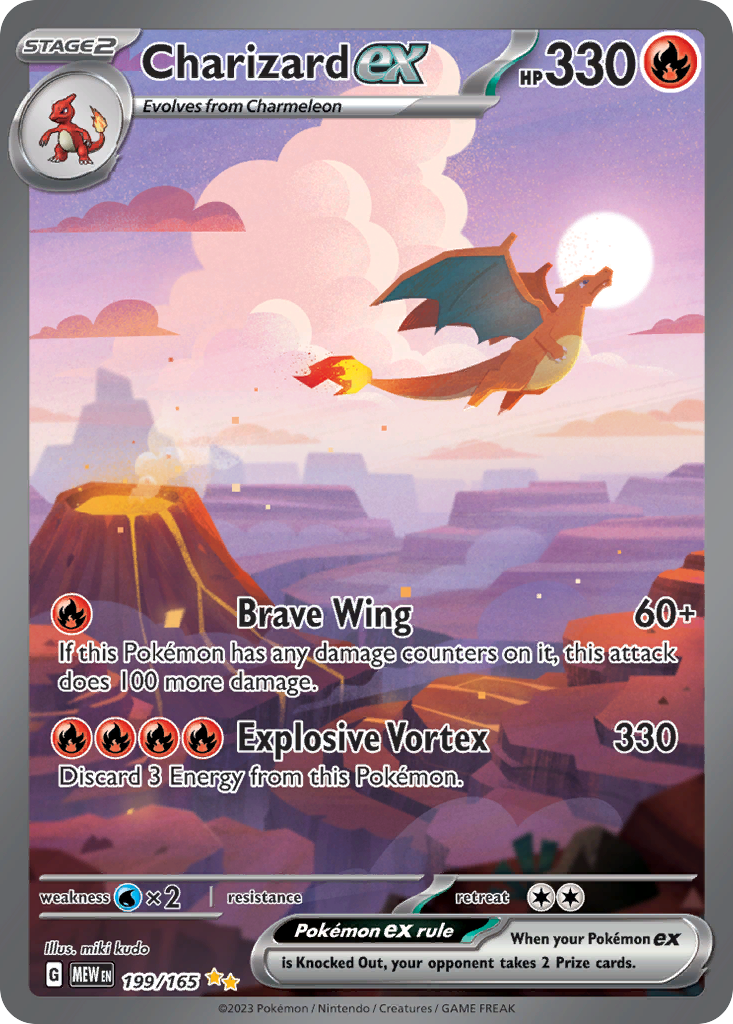
Scarlet & Violet: 151 released September 22, 2023 as a nostalgia-driven reimagining of the original 151 Kanto Pokémon, and its Charizard ex Special Illustration Rare has been the set’s headline chase card since day one. Unlike Champion’s Path, this one hasn’t just faded after the initial hype — 151 has since gone out of print, and reported shortages through 2025 and into 2026 pushed the top chase cards, Charizard included, to fresh highs rather than a slow bleed.
Pricing here is genuinely more volatile than the other three cards on this list, and different trackers don’t fully agree: raw near-mint copies have generally traded in the $300–$400 range through 2024–2026 (one snapshot showed a -35% pullback to $325 in a single 30-day window), while PSA 10 copies have been reported anywhere from roughly $800 to over $2,000 depending on the month and the source. Treat any single number here as a rough midpoint, not gospel — this is a young card in an unusually thin, fast-moving market.
The caveat: “went out of print” is doing a lot of work in that price strength, and Pokémon has leaned hard into Kanto nostalgia sets since 151 — a future reprint or a similar 25th/30th-anniversary-style set could reintroduce supply and cool this card off the same way Champion’s Path cooled. If you want a modern Charizard with room to grow, a Charizard ex Special Illustration Rare (151) is a reasonable entry point, but go in knowing “sold out” doesn’t mean “permanently scarce” in a hobby that reprints Charizard more than almost any other card.
Charizard Price History at a Glance
| Card | Set / Year | Rarity | Launch-era price | Roughly today (Aug 2026) | What happened |
|---|---|---|---|---|---|
| Charizard (1st Ed.) | Base Set, 1999 | Rare Holo | ~$3 pack pull | $180,000–$550,000+ PSA 10; Japanese no-rarity-symbol copy hit $1.7M (Mar 2026) | Decade of flat pricing, then a boom, a real 2-year correction, then new records |
| Charizard | XY: Evolutions, 2016 | Rare Holo (reprint) | ~$15–40 raw | ~$90–125 PSA 10 | Rode the 2020–21 boom, corrected, now stable and modest |
| Charizard VMAX (Rainbow) | Champion’s Path, 2020 | Secret Rare | ~$500 (launch week) | ~$230–235 (raw market) | Classic hype spike, lost more than half its value, flat since |
| Charizard ex | 151, 2023 | Special Illustration Rare | Hyped from release | ~$300–400 raw; PSA 10 ~$800–2,000+ | Still climbing on real scarcity, but young and volatile |
Prices are approximate and pulled from auction results, TCGplayer market data, and price-tracking sites as of mid-2026; individual sales vary by centering, edge wear, and which grading company’s slab it’s in.
What This Pattern Actually Teaches Collectors
Lay all four side by side and a few honest patterns emerge — none of them “just buy Charizard and wait”:
- Scarcity, not the character, drives long-term value. The 1999 card and the 2016 reprint share almost identical artwork. One is worth six figures; the other is worth about a hundred dollars. The print run and grading population are the whole story.
- Launch-week hype is not a price floor. Champion’s Path proves a card can lose more than half its value within a few years of a red-hot release. Buying at launch because “it’s Charizard” has burned a lot of collectors.
- Even the “safe” vintage card isn’t a straight line up. The 1st Edition Base Set Charizard spent 2022–2024 down 30–40% from its 2021 peak before setting new records in late 2025 and 2026. If you needed to sell during that window, “Charizard always goes up” wasn’t true for you.
- Reprint risk is real and ongoing. Charizard has appeared on well over 100 different English-language cards across dozens of sets. Pokémon leans on this character constantly, and every new nostalgia-branded reprint is a small headwind against any specific modern Charizard’s scarcity story.
Is Charizard Still a Good Long-Term Hold in 2026?
For the specific 1999 1st Edition Base Set copy, the multi-decade trend line is up, but with a genuine multi-year drawdown in the middle and pricing so far into “not a casual purchase” territory ($180,000+) that it isn’t really comparable to buying a modern single. For modern chase cards like the 151 SIR or a fresh VMAX/ex, the honest read is: some hold value better than others depending on print run and whether the set stays in print, and past examples (Champion’s Path) show real downside risk. None of this is a recommendation to buy or sell — card values are driven by nostalgia cycles, grading population growth, and reprint decisions that Pokémon’s parent companies control, not you.
Frequently Asked Questions
Is a Base Set Charizard still worth buying in 2026?
Only if you’re buying it because you love the card, not as a short-term flip. PSA 10 1st Edition copies now run $180,000 and up, non-1st Edition and lower grades are dramatically cheaper, and the market has already shown it can drop 30–40% for a couple of years even for this card. If budget is a concern, an Evolutions or 151-era Charizard captures the artwork and nostalgia at a tiny fraction of the price.
Why do some Charizard cards cost $5 and others cost over $1 million?
Print run, grading population, and edition (1st Edition vs. Unlimited, English vs. Japanese variant) are the main drivers — not the artwork or the Pokémon itself. A 2016 reprint using nearly identical art to the 1999 original sells for around $100 in top grade, because millions more copies exist and almost none are considered truly rare.
How can I tell if a vintage 1999 Charizard is authentic before I buy it?
Given the dollar amounts involved, this is the single most faked and most re-holdered card in the hobby. Buy graded copies only from established auction houses (Heritage, PWCC) or verified marketplace sellers, check the PSA/CGC certification number against the grading company’s own lookup tool, and be wary of any “too good to be true” raw listing. See our full guide to buying Pokémon cards online safely for red flags and verification steps.
Does getting a Charizard graded actually increase what it’s worth?
For high-value vintage copies, yes — a PSA 10 slab commands a massive premium over a raw or lower-graded copy, which is why grading fees make sense on a card that might already be worth thousands. For a $20–50 modern card, grading fees (often $15–80+ per card) can easily exceed any resale premium. Our PSA vs. CGC vs. BGS grading guide breaks down current pricing and when grading actually pays off.
Will modern Charizard chase cards like the 151 SIR or Champion’s Path VMAX ever be worth what the 1999 card is worth?
Almost certainly not in the same order of magnitude, at least not soon. The 1999 card’s value comes from being the character’s first-ever appearance combined with 25-plus years of nostalgia and a genuinely small surviving population in top grade — conditions modern mass-printed cards haven’t had time, or scarcity, to replicate.
Related Articles
More Trading Card Game Guides
- One Piece Card Game Chase Card Prices: 2022-2026 History (One Piece Card Game)
- Dragon Ball Fusion World Chase Card Price History (2024-2026) (Dragon Ball Super Card Game)
- Naruto Card Game Gen Con 2026: What Actually Happened (Naruto Card Game)
Comments